
The quiet ones will go unnoticed until they have to speak up or stand up or defend themselves. Then they are suddenly put on public display. And that isn’t usually a good thing. Because when the quiet ones are suddenly in the spotlight, it means their lives or livelihoods or routines have been disrupted. It means that they have had to publicly take a stand for an issue they held close but didn’t necessarily plan to share with the general public. And now they’re exposed.
Being exposed isn’t always a bad thing. But exposure for the quiet ones is unwelcome. Unwanted. Unasked for. And the exposure may show how deep or how shallow their faith really is. So come prepared to stand tall and strong when you’re unexpectedly thrust into the spotlight. Be prepared to give an answer for the cause you’re supporting.
The quiet ones prefer to be in the background. To be unseen. Unheard. Unnoticed. Especially in a crowd. But one on one, they feel more comfortable. They may even shine. When one on one, they can let down their guard and talk about what needs talked about. But don’t ask them to speak in public. And they, most likely, will never raise their hand in a room full of people. Even if they know the answer to the question. Even if they have a question. They just won’t ask it. Because then they will be seen. And heard. And someone just might notice how awesome they are and expect them to speak up more often.
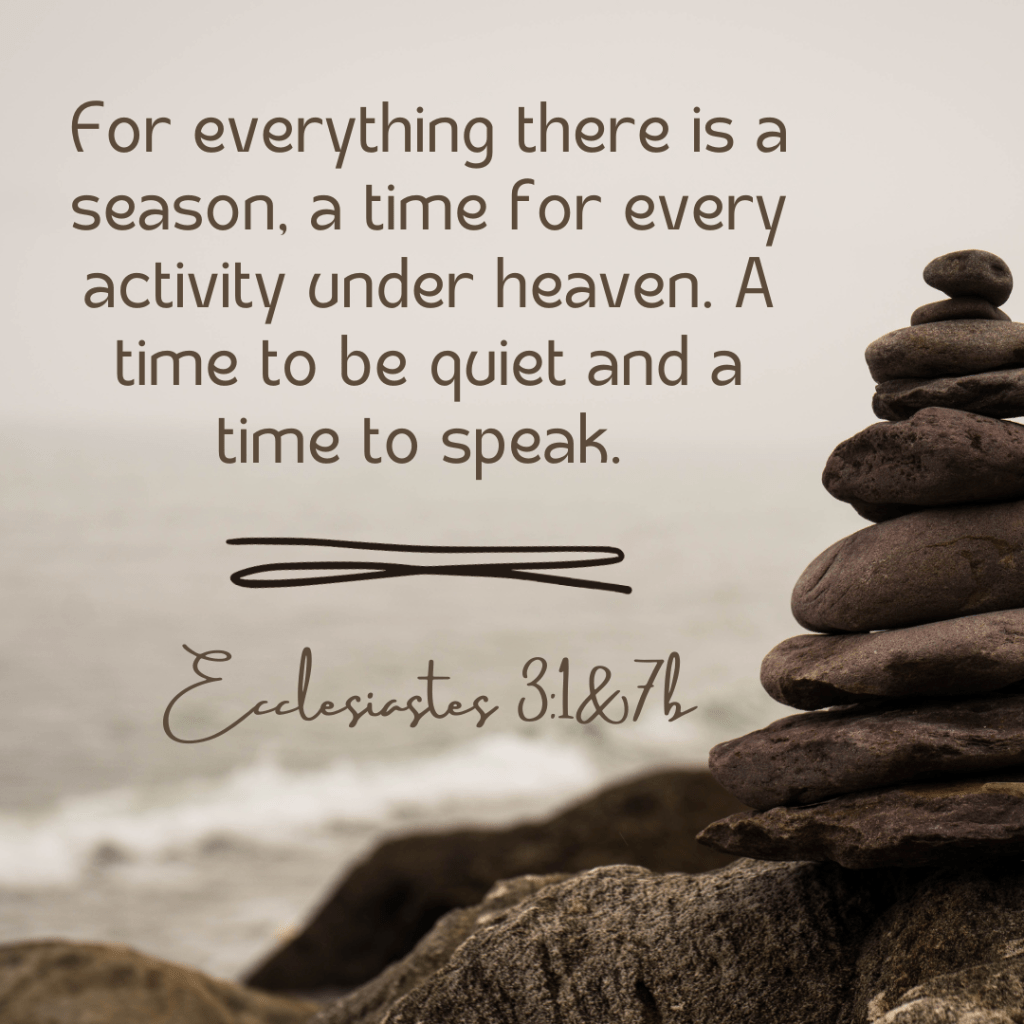
For everything there is a season, a time for every activity under heaven. A time to be quiet and a time to speak. Ecclesiastes 3:1&7b
The man who offered to bury Jesus was Joseph from the city of Arimathea. He was a member of the Sanhedrin, which was the judicial ruling body of the day. This group had unanimously voted to crucify Jesus. Since the vote was unanimous, either Joseph voted in favor of the crucifixion or he wasn’t present when the vote was taken. Perhaps he abstained from the vote. Either way, he most likely felt he had failed the Messiah. What the Sanhedrin didn’t know was that Joseph was a secret disciple of Jesus. He kept his faith quiet, because he lived in fear of the Jewish leaders he consorted with. And he alone asked to take the body of Jesus for burial. No one else asked. Not the disciples. Not the women at the crucifixion. No one else asked to bury Jesus’ body. Only this one secret disciple.
Another man named Nicodemus helped Joseph bury the body of Jesus. Nicodemus was a Pharisee, and he was also a member of the Sanhedrin. He had once met Jesus face to face under the cover of darkness. He had questions about who Jesus was. Perhaps he was asking the questions out of personal interest, or perhaps he had been sent by the Sanhedrin to learn more about this man they so hated. But on the evening, as others were preparing for the Sabbath, these two men brought spices and linen and prepared the body of their beloved Savior for burial. These two men who never publicly spoke of their faith selflessly performed one final public act for their Lord.
Afterward Joseph of Arimathea, who had been a secret disciple of Jesus (because he feared the Jewish leaders), asked Pilate for permission to take down Jesus’ body. When Pilate gave permission, Joseph came and took the body away. With him came Nicodemus, the man who had come to Jesus at night. He brought about seventy-five pounds of perfumed ointment made from myrrh and aloes. Following Jewish burial custom, they wrapped Jesus’ body with the spices in long sheets of linen cloth. John 19:38-40
These two men, Joseph and Nicodemus, held powerful positions. They were both members of the ruling group. They were wealthy and influential men of their day. They were not strangers to each other. But they each lived in private fear of public humiliation. They kept their faith quiet. But in a moment of faithfulness, they buried the body of their Savior. Anyone who hated Jesus and despised what he stood for would have cared less what happened to the dead body of a man who called himself the Son of God. These two men acted in reverent love for the One who would rise from the dead on the first day of the new week. They risked everything. Their lives. Their families. Their careers. All for the act of removing the body of Jesus Christ from the cross and burying him in a tomb. There is no record in the Bible of what happened to these two men afterwards, but historical documents show that they paid a huge price for this act of love.
Many people today openly share their thoughts for or against hot button issues of the day. And, somehow, it’s assumed that the loudest voices are the most popular. Not necessarily. Each of us may be known as one who is quiet about our faith or our convictions on current events. We don’t always have to speak up about our differences, unless God leads us to share. If we know that our differences will only cause friction, we have to ask ourselves if it’s the right time to speak up. Other times, as directed by God, we will perform acts of servanthood to others.
Our time of service or our words of faith can be far more reaching than we may ever know. Our faithfulness is the key. We must always be ready to give an answer for our faith when asked. We must perform acts of love and selflessness when called on. Oh. These words of faith and these acts of love may be misinterpreted, and we may be treated unfairly for them. But regardless of the outcome or the outcry against us, we must stand strong in our faith. And we must be prepared to risk everything by speaking or acting for an unpopular faith or belief.
 Mercy for the Day