Dressed for the Occasion

They were the ruling party of the day. They knew they had control of the people, and they liked it that way. Power is everything to some people, and some people abuse that power. And in this very moment, they were abusing the power that had been vested to them by the authorities. And they didn’t care. Who would challenge them? Who would call them out for their unlawful behavior? Who would dare?

A man was on trial for a belief the ruling party didn’t agree with. So they brought in their own attorney to tell a version of the story that was far from the truth. They even provided witnesses who didn’t witness the so-called crime. They were determined to put this man away for what life he had left in him. And rightly so, because he was a threat to their way of ruling. He spoke words that went directly against their ideologies, and he was in the way. A menace to society, some would say.

Funny thing is. This man didn’t even have an attorney. He spoke in his own defense. But no worries. His speech was eloquent and accurate. He did not embellish his story. He just told the plain truth. His delivery was on point. There was no denying that. He had been called a troublemaker and a ringleader. He was accused of desecrating the holy place where everyone worshipped. Only he hadn’t.

This man’s name was Paul. What this ruling party failed to remember, or perhaps didn’t know, was that Paul had once sought and approved of the killing and imprisonment of people who called themselves Christians. And now. Here he was. The roles had been reversed, and he found himself on the receiving end of imprisonment and possible death for being a Christian. Oh. Paul was aware of the dangers, but he felt God’s call on his life to share the message of salvation.

It was obvious to Paul and the men who traveled with him that the leaders in Jerusalem had rejected the gospel message. And by doing so, they rejected anyone associated with it. Not only were there multiple incidents of the message being rejected locally, but violence was ramping up against Paul and other believers. So when Paul spoke publicly about Jesus Christ and the need for salvation, a spotlight was pointed straight on him. But it didn’t silence him.

You can read this story about Paul in Acts 24-26.


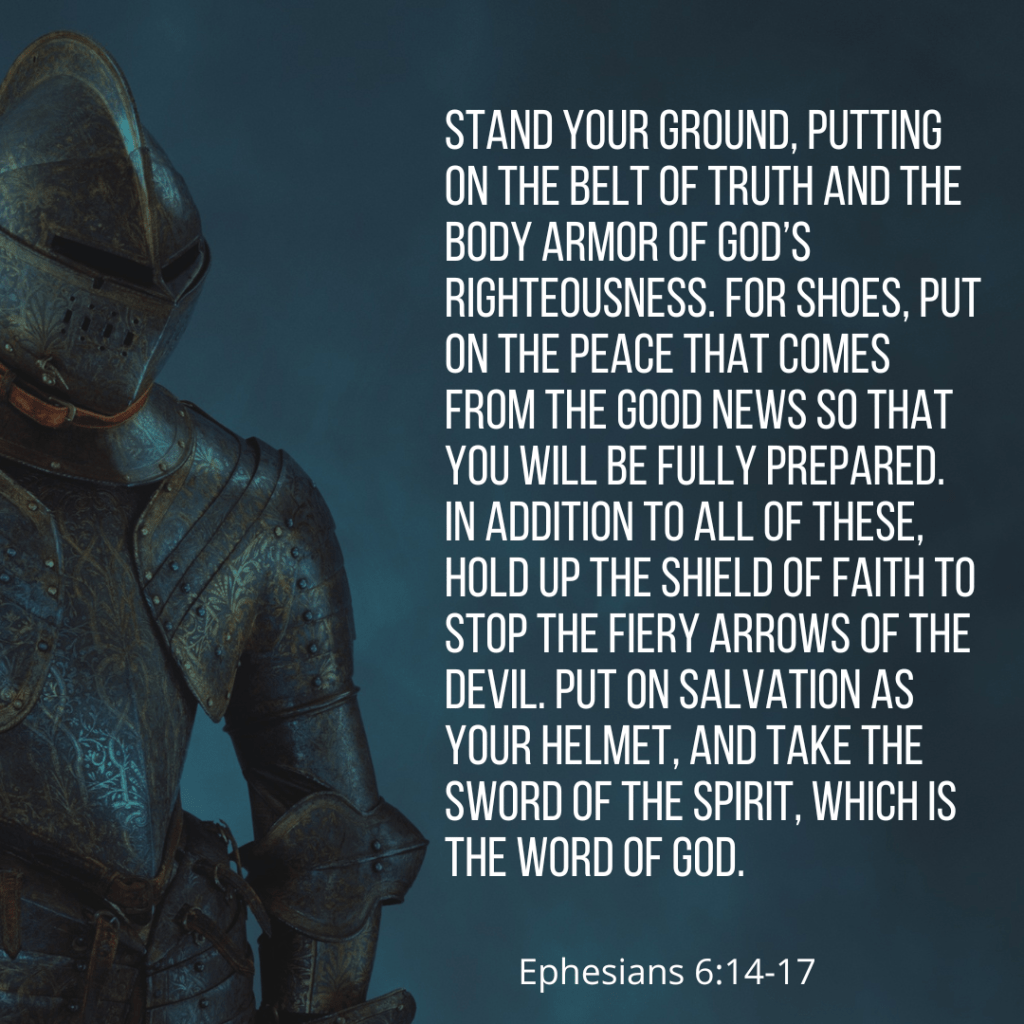
Stand your ground, putting on the belt of truth and the body armor of God’s righteousness. For shoes, put on the peace that comes from the Good News so that you will be fully prepared. In addition to all of these, hold up the shield of faith to stop the fiery arrows of the devil. Put on salvation as your helmet, and take the sword of the Spirit, which is the word of God. Ephesians 6:14-17


Oh. Paul knew who he was fighting against. He knew the enemy, because he had once been a soldier in the enemy’s camp, all the while thinking he was fighting for a righteous cause. But he had been fooled. And when his eyes were opened, he realized the error of his ways. He had not been on the winning team, even though he had fully believed he was. But once the scales fell from his eyes, he surrendered to the God who had called his name on that road to Damascus. And ever since that day, he was fighting a winning battle even when he appeared to be losing. He was, at long last, on God’s side and would fight mightily for him until his last exhale of breath. Paul knew his final victory would be to spend eternity with his Savior, so fight he must.

For we are not fighting against flesh-and-blood enemies, but against evil rulers and authorities of the unseen world, against mighty powers in this dark world, and against evil spirits in the heavenly places. Ephesians 6:12

In Paul’s letter to the church at Ephesus, he gave them basic instructions on how to stand unwavering in their faith. He taught them how to get dressed in the full armor of God every day, because that’s how he stood ready and prepared for the spiritual fight of his life. As he stood in front of the courts that day, he wore the full armor of God and was able to stand his ground speaking the truth boldly and confidently.

This body armor was not visible to the naked eye, but its effects were on full display. Those in the courtroom heard the full truth of Paul’s story, and God’s righteousness protected his heart from being wounded by sin. Paul walked into that arena in peace knowing that he was anchored and standing firm in his faith. He carried the shield of faith, so the enemy’s fiery arrows couldn’t reach him. By wearing the helmet of salvation, Paul’s every thought was protected by God. Satan’s stronghold was no threat over him. Lastly, Paul used the Word of God as a sword against Satan’s temptations. Paul was covered head to toe in God’s armor.

As believers, we too are called to be fully dressed in God’s armor every day. When we stand before our accusers for thought crimes or words of truth, we must be prepared to stand in defense of the truth. We must use every piece of God’s armor to defend our faith. Others may not see God’s armor, but as we wear it each day they will see God’s work in us as we reject Satan’s advances on our faith.

This spiritual warfare is a battle every believer faces, so we must be dressed for the occasion. As soldiers in the army of God, we must be armed at all times. No warrior enters the battle without their weapons. We can be encouraged knowing that God has provided his protection for us with this suit of armor. Those who know the strength and power of the suit will recognize its work as we publicly live out our faith.

The Quiet Ones

The quiet ones will go unnoticed until they have to speak up or stand up or defend themselves. Then they are suddenly put on public display. And that isn’t usually a good thing. Because when the quiet ones are suddenly in the spotlight, it means their lives or livelihoods or routines have been disrupted. It means that they have had to publicly take a stand for an issue they held close but didn’t necessarily plan to share with the general public. And now they’re exposed.

Being exposed isn’t always a bad thing. But exposure for the quiet ones is unwelcome. Unwanted. Unasked for. And the exposure may show how deep or how shallow their faith really is. So come prepared to stand tall and strong when you’re unexpectedly thrust into the spotlight. Be prepared to give an answer for the cause you’re supporting.

The quiet ones prefer to be in the background. To be unseen. Unheard. Unnoticed. Especially in a crowd. But one on one, they feel more comfortable. They may even shine. When one on one, they can let down their guard and talk about what needs talked about. But don’t ask them to speak in public. And they, most likely, will never raise their hand in a room full of people. Even if they know the answer to the question. Even if they have a question. They just won’t ask it. Because then they will be seen. And heard. And someone just might notice how awesome they are and expect them to speak up more often.


For everything there is a season, a time for every activity under heaven. A time to be quiet and a time to speak. Ecclesiastes 3:1&7b


The man who offered to bury Jesus was Joseph from the city of Arimathea. He was a member of the Sanhedrin, which was the judicial ruling body of the day. This group had unanimously voted to crucify Jesus. Since the vote was unanimous, either Joseph voted in favor of the crucifixion or he wasn’t present when the vote was taken. Perhaps he abstained from the vote. Either way, he most likely felt he had failed the Messiah. What the Sanhedrin didn’t know was that Joseph was a secret disciple of Jesus. He kept his faith quiet, because he lived in fear of the Jewish leaders he consorted with. And he alone asked to take the body of Jesus for burial. No one else asked. Not the disciples. Not the women at the crucifixion. No one else asked to bury Jesus’ body. Only this one secret disciple.

Another man named Nicodemus helped Joseph bury the body of Jesus. Nicodemus was a Pharisee, and he was also a member of the Sanhedrin. He had once met Jesus face to face under the cover of darkness. He had questions about who Jesus was. Perhaps he was asking the questions out of personal interest, or perhaps he had been sent by the Sanhedrin to learn more about this man they so hated. But on the evening, as others were preparing for the Sabbath, these two men brought spices and linen and prepared the body of their beloved Savior for burial. These two men who never publicly spoke of their faith selflessly performed one final public act for their Lord.

Afterward Joseph of Arimathea, who had been a secret disciple of Jesus (because he feared the Jewish leaders), asked Pilate for permission to take down Jesus’ body. When Pilate gave permission, Joseph came and took the body away. With him came Nicodemus, the man who had come to Jesus at night. He brought about seventy-five pounds of perfumed ointment made from myrrh and aloes. Following Jewish burial custom, they wrapped Jesus’ body with the spices in long sheets of linen cloth. John 19:38-40

These two men, Joseph and Nicodemus, held powerful positions. They were both members of the ruling group. They were wealthy and influential men of their day. They were not strangers to each other. But they each lived in private fear of public humiliation. They kept their faith quiet. But in a moment of faithfulness, they buried the body of their Savior. Anyone who hated Jesus and despised what he stood for would have cared less what happened to the dead body of a man who called himself the Son of God. These two men acted in reverent love for the One who would rise from the dead on the first day of the new week. They risked everything. Their lives. Their families. Their careers. All for the act of removing the body of Jesus Christ from the cross and burying him in a tomb. There is no record in the Bible of what happened to these two men afterwards, but historical documents show that they paid a huge price for this act of love.

Many people today openly share their thoughts for or against hot button issues of the day. And, somehow, it’s assumed that the loudest voices are the most popular. Not necessarily. Each of us may be known as one who is quiet about our faith or our convictions on current events. We don’t always have to speak up about our differences, unless God leads us to share. If we know that our differences will only cause friction, we have to ask ourselves if it’s the right time to speak up. Other times, as directed by God, we will perform acts of servanthood to others.

Our time of service or our words of faith can be far more reaching than we may ever know. Our faithfulness is the key. We must always be ready to give an answer for our faith when asked. We must perform acts of love and selflessness when called on. Oh. These words of faith and these acts of love may be misinterpreted, and we may be treated unfairly for them. But regardless of the outcome or the outcry against us, we must stand strong in our faith. And we must be prepared to risk everything by speaking or acting for an unpopular faith or belief.

We Are Not All Right

He is the mayor of a large liberal city. During his campaign, he said he wanted to improve public safety, but his city is overrun with crime. He said he wanted to build a stronger, healthier city, and now the place is being swarmed with illegal immigrants brought in from the border. He said he wanted to reduce inequality, yet he now says the asylum seeker crisis will destroy his city. After the Hamas attack on Israel, he says enough is enough. He condemns the antisemitism that is being spread by this terrorist group, and he stands strong with Israel.

He has said that we are not all right. And he’s right. We are not all right in this world. The world seems to be collapsing in on itself with no plan for course correction. Oh. We can’t move back the hands of time to a kinder, gentler day. We just can’t. Time continues to move forward even during days of unnecessary evil. It’s just the way life goes. One second becomes two and so on. The peace we once had is gone. The safety we once felt is gone. The time to be complacent is long gone. The courage we never knew we needed is now badly needed.

We can’t return to the good ole’ days, because today is all we have. Tomorrow is not a guarantee, and yesterday is spent. We’re told we need safe spaces where we won’t feel threatened. But what exactly is a safe space, and who is it safe for and safe from what?

In the New Testament, Paul warned his traveling companion, Timothy, that times will be difficult in the last days. And they thought they were living in the last days. Oh. If only they could see us now.

You should know this, Timothy, that in the last days there will be very difficult times. For people will love only themselves and their money. They will be boastful and proud, scoffing at God, disobedient to their parents, and ungrateful. They will consider nothing sacred. They will be unloving and unforgiving; they will slander others and have no self-control. They will be cruel and hate what is good. They will betray their friends, be reckless, be puffed up with pride, and love pleasure rather than God. They will act religious, but they will reject the power that could make them godly. Stay away from people like that! 2 Timothy 3:1-5

We’re told that in the last days, there will be wars and rumors of wars. Nations will go to war. There will be famine and earthquakes. There will be persecution of believers. There will be false teachers and false prophets.

Jesus told them, “Don’t let anyone mislead you, for many will come in my name, claiming, ‘I am the Messiah.’ They will deceive many. And you will hear of wars and threats of wars, but don’t panic. Yes, these things must take place, but the end won’t follow immediately. Nation will go to war against nation, and kingdom against kingdom. There will be famines and earthquakes in many parts of the world. But all this is only the first of the birth pains, with more to come. “Then you will be arrested, persecuted, and killed. You will be hated all over the world because you are my followers. And many will turn away from me and betray and hate each other. And many false prophets will appear and will deceive many people. Sin will be rampant everywhere, and the love of many will grow cold. But the one who endures to the end will be saved. And the Good News about the Kingdom will be preached throughout the whole world, so that all nations will hear it; and then the end will come. Matthew 24:4-14


Never stop praying. Be thankful in all circumstances, for this is God’s will for you who belong to Christ Jesus. 1 Thessalonians 5:17-18


There were courageous believers in the Bible who lived through harrowing times. They were persecuted. Their faith was challenged. Their lives were threatened. Things were not all right in their world. Yet they held firm to the conviction that they would serve God regardless of the cost. Two people I think of time and again are Daniel and Esther. Their faithfulness to obeying God’s leading and standing strong in their faith during challenging cultural times is a reminder that my faith doesn’t have to waver in today’s cultural crisis. I too can live in obedience to God’s commands without defiling my relationship with him, even when culture today is pushing in direct opposition to biblical truths.

Daniel lived over sixty years in a foreign land. Taken as an exile as a teenager to Babylon, he never returned home to Israel. His name was forcibly changed to represent a false god. He was indoctrinated with mystical and ungodly teachings. He worked for an employer hostile to his faith during his entire career. He achieved honors and promotions in his career all the while serving kings who disregarded God as the One True God. Yet every time he was pushed to defile his faith in God, he refused. He stood strong in his convictions, regardless of the cost. He never lost faith. He was faithful throughout his life, enduring much loss. And he was highly respected by the kings he worked with throughout his adult life. God honored Daniel’s faithfulness, yet Daniel never lived as a free man.

Esther was a young Jewish woman born into exile in the Persian city of Susa. When the Persian king, Ahasuerus, banished Queen Vashti for refusing to entertain his guests, he began the hunt for her replacement. In a sweep of all the young virgin women, Esther was placed in his court. Each candidate was to spend one night with the king. The one he favored would become queen. Esther, giving up all her hopes and dreams for the future, was forced into a life not of her choosing. Yet God saw her and placed her in the king’s court where she was crowned queen. She found favor in the king’s eyes, and yet the King of Kings favored her and heard her prayers. Her people were not all right. Their lives were being threatened, but through a series of events Queen Esther was able to save her Jewish people from annihilation.

As a nation, we are not all right. We have open borders where young military age men are streaming into this country unchecked and unvetted. We have elderly leaders in top political positions who are unfit for office. We have a presidential candidate, a former head of state, who could end up in prison. Our country is funding a war that is none of our business. Corruption runs deep in the deep state, but it’s a risky business to bring it to an end. Something is very wrong.

We’ve replaced God in schools with extreme ideologies that corrupt young minds. We now push equity over equality. We allow unqualified candidates to edge out the more qualified ones for jobs, and then we are confused when the work suffers. Something is very wrong.

We’re forced to consider everyone’s selected pronouns. We scream in protest when women’s feminine products are removed from men’s restrooms. We applaud when men win women’s sports events and beauty contests. We name a biological man as woman of the year. We’re extremely concerned about the atrocities being exacted upon innocent lives in Israel and Palestine. We hear of babies being beheaded in the Middle East, all the while smiling on the beheading and dismembering of innocent unborn babies in this country. We are not all right.

Our country is focused on issues that have turned our culture into an unrecognizable mess. We’ve been heading down a dark abyss for decades, and we’ve lost our way. Our country is in chaos, and it doesn’t have to be this way. The powers that be have a plan in place to destabilize the country and keep us in a constant state of chaos. We are not all right.

We are not all right. That is definitely true. Is it too late to turn this nation back to God? Can we find our way back? That is the question we are facing. Can this country be turned around to afford more people time to answer the call to surrender their lives and their wills to Jesus Christ? Because that is our only hope. But it’s not just about this great nation we live in. Our country is not the entire world, and evil abounds in every nook and cranny of the globe. Evil and corruption are found in the elite board rooms all the way down to the dirt floor hovels all over the world.

It appears that we’re moving closer and closer to the time Jesus Christ will meet his followers in the sky and take them to heaven with him. But until that time comes, Satan will continue to expand his reach into every area of life. God is allowing Satan to exert more and more power in the world. Our hope is to pray for God to extend his mercy to us and delay his judgment on many unsuspecting souls. It’s time to pray without ceasing, because the day is coming when Satan will have full control for a short time. Then Jesus will soundly defeat him in record time.

Then the man of lawlessness will be revealed, but the Lord Jesus will slay him with the breath of his mouth and destroy him by the splendor of his coming. 2 Thessalonians 2:8

No. We are not all right. But God can make all things right in our hearts if we bow before him and confess him as Lord and Savior of our lives. Then, regardless of our circumstances, everything is all right.

And the one sitting on the throne said, “Look, I am making everything new!” Revelation 21:5

The Art of Doing Hard Things

So then there’s Jeremiah. He was a prophet who shared God’s message of impending doom to the people of Israel and Judah. The problem is. They didn’t listen to him. They mocked him. They shunned him. They threatened him. They ignored him. They didn’t like him. They wanted him dead. But they didn’t kill him. Oh. He suffered physically and mentally. He lived with deep anguish. He wanted to give up. He asked God why he was even born. He wondered if it would have been better if he had been born dead. But he wasn’t. He was to live the life that God had laid out for him. Every single day. Whether the day was good or bad. He was used by God to warn his people that they must repent and turn from their sinful ways.

And then God asked the impossible of him. God told him not to marry and have children. God said that if he did, his family would be among other families to die horrible deaths. They would have no one to mourn or bury them.

The Lord gave me another message. He said, “Do not get married or have children in this place. For this is what the Lord says about the children born here in this city and about their mothers and fathers: They will die from terrible diseases. No one will mourn for them or bury them, and they will lie scattered on the ground like manure. They will die from war and famine, and their bodies will be food for the vultures and wild animals.” Jeremiah 16:1-4

Jeremiah was involved in political and religious events during his day. He was a spiritual leader who faithfully served God. He showed great courage as he shared God’s word with God’s chosen people. He spoke on the Lord’s behalf to a people who didn’t want to hear what he had to say. He felt great sorrow as he saw his nation moving toward destruction. If only they listened, they could be spared future devastation. His was not an easy life.

For his entire career, Jeremiah served in a position where he was unfairly treated and criticized. His words fell on deaf ears, but others felt free to speak ill of him. Oh. He was born into a family of priests. That was his expected line of work. But somehow. God had other plans for him. He was a God ordained prophet who was given the task of sharing God’s impending punishment on a people who despised him. His was not an easy job.

Jeremiah held a deep love for his fellow Israelites, yet he knew the punishment headed their way if they didn’t return to obeying God. He was also deeply concerned about his personal safety, because he knew that speaking directly against the fallen people put a bullseye on his back. Yet he stood faithful in delivering God’s message of impending judgment.


This is my command—be strong and courageous! Do not be afraid or discouraged. For the Lord your God is with you wherever you go. Joshua 1:9


I think of the young woman who was a collegiate swimmer. Her plan was to attend dental school, yet she somehow finds herself in another profession at this moment. After being a victim of unfair discrimination, she speaks out against the ideology that men participating in women’s sports is fair. She has stood in a women’s locker room with a male posing as a female and has felt the discomfort the situation caused for her and her female teammates. She has remained faithful to her call for only women to participate in women’s sports. Yet she is ridiculed and persecuted for speaking the truth. She has felt the bitter sting of rejection. She has been isolated and physically assaulted, yet she continues with her message. She now expects to see protesters at any event where she is scheduled to speak. She knows they are out to silence her. Yet she still speaks.

Oh. Her message isn’t one of spiritual salvation, yet it is significant. If falsehoods are accepted as truth in any area of life, then biblical truths are also on the line. This young woman is no prophet or biblical scholar, yet she is a faithful believer in Jesus Christ. She has accepted the call to be a voice for young women coming behind her who may also be asked to step aside for a lie. She doesn’t want anyone else to be in a situation similar to hers.

Sure. There are those who support her message of fairness. Behind closed doors, they too tell her they want to save women’s sports. But those who show support in private are silent in public. Shame on them. I get it. They’re fearful for their jobs. Their career may be on the line if they challenge the new status quo. They don’t want to be cancelled or sued. So they stay silent. But if no one speaks up, then women’s sports is a thing of the past.

The message of truth is offensive to those who deny it, but it doesn’t make the truth less powerful. Being offended doesn’t change the truth. But the messenger of truth must remain faithful, at all costs.

In no way am I trying to compare a college swimmer to a Jewish prophet, but they both showed tremendous courage when called upon to speak truth to those who opposed it. They and many others who dare to show courage in uncertain times are to be applauded and thanked. Their example of faithful obedience is a lesson each of us must learn. Who knows when we may be called on to stand for truth and face the difficulties of doing so. Hard times may come upon us, but we must let the example of those who come before us embolden us to always be a voice for truth.

God is our refuge and strength, an ever-present help in trouble. Psalms 46:1

Backbone Needed

The king was waiting in his palace for Daniel to explain the meaning of his disturbing dream. He knew Daniel could tell him what this dream meant, because he had interpreted a dream for him years earlier, with the help of his God. So he could do it again. So could his God.

And Daniel was given the opportunity and the challenge of speaking God’s truth to the king. Oh. God gave him the meaning of the dream. And he had a slight hesitation as he realized the impact the meaning of the dream would have on the king. He knew it would be life changing. He just didn’t know if his own life would be at risk for telling the truth. But the king, in his love for Daniel, gave him permission to tell the true meaning of the dream. No holds barred.

Was Daniel fearful for his own life or for the life of the king? After all, this news would be devastating to the king who thought he didn’t need God. Daniel and the king had worked together for many years. It would be very difficult to give bad news to your boss. It was news that would cause the king’s knees to crumble. His power would be gone. Daniel begged him to repent.

Some would pray for the opportunity of a lifetime to let one in a noble position know that they’re a sinner in need of a Savior.  Yet Daniel was overcome by emotion and concern.  He knew the gravity of the meaning of the dream.  He knew that it was a judgment from God on King Nebuchadnezzar’s pride and disobedience.  How do you say those words out loud in front of an audience of the king? Were the other wise men still standing there? Would he have to say the difficult words in mixed company?  I mean.  This was a personal message from God himself. No one said that the king had excused everyone else in the room.  So Daniel had to be the bearer of good and bad news. 

Daniel began his dialogue with humility and love for the king. Although they were on different sides of the fence with their faith, they deeply respected each other. Daniel knew just the wrong word or attitude could send him to prison or death. Yet this king also knew of Daniel’s deep, abiding faith in God. He urged Daniel to speak the words of truth to him. Daniel let the king know that he wanted only the best for him, yet this dream told of troubles ahead for the king. A kind of trouble not typically afforded a wealthy, successful king. As he shared the meaning of the dream, Daniel spoke with courage and honesty. He left no detail undone. And then he shared hope. He shared that all would not be lost. The kingdom would be held in trust for when the king returned to his rightful throne. Then he finished his message with a plea for the king to stop sinning and to do what was right.


I am sending you out as sheep among wolves. So be as shrewd as snakes and harmless as doves. Matthew 10:16


Read this part of Daniel’s story in Daniel 4:19-27.

When we’re faced with speaking hard spiritual truths to those in authority or even to family members, we must do so with love and honesty. We come face to face with those in need of a Savior on a daily basis. We must keep them in our prayers and shower them with love and truth. We can’t go along with what’s popular in the world today. We must go with what’s right. Even when there might be a cost for us.

Like Daniel, we must be willing to share with others why they too need a Savior. We may have to tell them that God isn’t pleased with their disobedience and disregard for his commands. Perhaps we will have to share that there is a punishment for disobedience. But those truths can only be given with a gentle and humble attitude. We are all sinners in need of a Savior.

We don’t know what message God may ask us to share with someone who is running from him. But we do know that he will be with us as we share hard truths and genuine love. Let’s not run from those difficult conversations, but let’s put our hand in God’s as he leads us to share his love to a lost world.

But how can they call on him to save them unless they believe in him? And how can they believe in him if they have never heard about him? And how can they hear about him unless someone tells them? And how will anyone go and tell them without being sent? That is why the Scriptures say, “How beautiful are the feet of messengers who bring good news!” Romans 10:14-15

Keep your heart soft. Pray for people with whom you disagree.

Alisa Childers

A Long Obedience

When Daniel was a teenager, he was captured from his home in Jerusalem and taken to Babylon. There he spent three years being indoctrinated into the Babylonian culture, religions and traditions. He was then chosen to serve as a wise man in the royal court of King Nebuchadnezzar. Daniel was a Jew. He was raised in a country that had rejected God, yet he was taught that God was the God of his people. Even though the king of his homeland had rejected God, there remained a faithful remnant in the land. Yet, that didn’t keep the followers of God safe from their enemy. Daniel became a prisoner of war. He wasn’t free to leave Babylon and go home to Jerusalem. He never returned home and was to be an exile for the rest of his life. Some would think he never reached his full potential living in a foreign land.

Daniel now lived in a heathen country that did not recognize God as the One True God. The Babylonians worshipped many gods. When he had been taken captive, the king had even changed Daniel’s name to Belteshazzar. His new name was the name of one of Nebuchadnezzar’s gods. The name Daniel means “God is my judge.” The god Bel was a powerless Babylonian god, while the God of Israel was the Creator of the heavens and the earth. The God of the Israelites was and still is living and breathing. He was and still is capable of hearing prayers and answering them. He is most powerful. Daniel knew this and never forgot it.

Daniel held true to his faith for his entire life. He gained solid teaching in his childhood while still in Jerusalem. Even though his native country had turned from serving God, someone taught him the Holy Scriptures that had been passed down for generations. He had learned to pray, and he knew prayer was a valuable lifeline. Perhaps it was his father who had taught him the Scriptures by rote repetition. Or perhaps, the young Jewish boys of his day were still taught the Torah, even though their nation’s leaders lived in direct opposition to God’s commands. Regardless of how he learned of God and to trust in him, he learned that lesson. And he learned it well. It was the most valuable possession he took with him as he was forced to travel the long journey from home to the foreign nation of Babylon. Little did he know just how much he would have to rely on God as his only source of strength and comfort for the remainder of his life.

But now. Roughly thirty years later, he finds himself called for an audience with the king. He now stood awaiting the king’s request. Once again, he had been asked to interpret another one of King Nebuchadnezzar’s dreams. All the other wise men stood in front of the king, yet not one of them could provide the meaning of this disturbing dream. And after all this time, Nebuchadnezzar was visibly relieved when Daniel walked through the door. He trusted Daniel and knew that Daniel would be able to interpret his dream. Why didn’t he just call for Daniel first thing, instead of bringing in all the other wise men?

The story of Daniel doesn’t allow us to witness Daniel’s faithfulness to God or even to his employer on a day-by-day or year-by-year basis. Yet this story shows us that as Daniel grew into a man who was now in his forties, his faith in God was deeper and stronger than it had been when he walked the path as a prisoner so many years earlier. He had learned that even when facing possible death, God was on his side. God was with him in those dark moments. And yet. He didn’t know what other trials were ahead. He faced the perils of living in a heathen culture all the while keeping his faith in God strong. He didn’t let the temptations and threats of the surrounding culture determine his faith. Those temptations and threats strengthened his resolve to obey God regardless of what he faced. He was immersed in an environment that bowed to many manmade gods, yet he didn’t bow a knee to them. Not once. He was determined to not let anything defile his relationship with God.


My grace is sufficient for you, for my power is made perfect in weakness. 2 Corinthians 12:9


Nebuchadnezzar was a religious man. He worshipped many gods. Yet his gods couldn’t help him in his times of deepest need. They never came through for him. But he trusted Daniel. And he knew that Daniel didn’t worship his gods. Daniel worshipped the One True God, the living God. Nebuchadnezzar respected him for his faithfulness to his faith, yet he never demanded that Daniel turn against God. Nebuchadnezzar realized he relied on Daniel’s God because he had seen his hand working in Daniel’s life. And he had also experienced the work of God in his own life. Yet he still refused to worship God. He only acknowledged God’s existence and power. He was full of pride and refused to bow to God.

Daniel’s allegiance to God never wavered during these thirty years serving a king who continually mocked God. There’s much we don’t know of those years between the king’s two dreams, yet we do know that on a daily basis Daniel stood fast in his devotion to God. If not, he wouldn’t have been faithful when a temptation or threat popped up. His faith was steadfast. It had been cultivated in hard times and nothing could deter him from it.

You can read this part of Daniel’s story in Daniel 4:4-18.

As believers in a hostile, heathen culture today, we are faced with temptations and threats we never thought possible. Yet here we are. We must do the hard work of studying God’s word and spending time in prayer so we are prepared for the challenges that we will face. We may not be called on to interpret a dream or bow to a foreign god. But we may be asked to call someone by a different pronoun. Or we may be mandated to perform tasks at work that go against our beliefs. We may be asked to bow a knee to an ideology that is in direct contradiction to God’s Word. We may be asked to say words we don’t believe. We may be required to sit through mandatory indoctrination of secular philosophies that are unbiblical. If we don’t know God’s Word. If we don’t spend time in prayer now. How will we be ready to face the fight when we’re suddenly in it? It could happen at any time.

Oh. It was thirty years in the making for Daniel. What he didn’t know was that he still had forty more years to go. His battles of working in a heathen environment never changed. His entire career was spent working in a situation that went directly against his beliefs. And yet he had a great reputation. His work was impeccable and he was favored by the king. Sure. The kings changed over time. The players in the king’s court changed. And some of the rules even changed. Yet Daniel’s faith and commitment to his God remained unchanged. Even during the darkest trials.

For his entire career, Daniel worked in a hostile environment. He didn’t know from one day to the next whether he life would be on the line. Sure. He had developed a relationship with the king. But kings can be fickle. And it wasn’t like Daniel could find another more suitable job. Where do you go after working for a hostile foreign king? If Daniel could work in a hostile environment for so many years and remain faithful to God, why can’t we? We wonder today if we should work only for companies that support our values. But Daniel didn’t have a choice and he was able to remain faithful to his God. We can’t always run from the situation we find ourselves in. Sometimes the only choice is to stay and stand strong amidst the daily rebukes thrown at us. When someone calls us horrible names, we can stand strong knowing who knows our true name and calls us by it. Remember. God is with us.

We may not have a choice but to remain in difficult situations. God may even require us to stay. We don’t know what lies ahead for any of us. What we do know is that if God is with us, those against us will not win in the end. We must keep our eye on our eternal prize. Not on an easy life on this earth. As followers of Christ, we aren’t called to an easy life. We’re not called to conform to current cultural trends. We’re called to be faithful and obedient to God. And the Bible clearly tells us that we will face suffering.

Let’s learn to be like Daniel. We must choose to be in the fight for our faith over the long haul. It isn’t a short-term commitment. It is a lifetime of choice. A lifetime of choosing to live in direct obedience to God’s will. To stand for God’s will and no one else’s. Let’s make the commitment. Let’s strengthen our faith and stand strong from this day forward. God’s strength is made perfect in our weakness.

Happy Birthday, America

This week America celebrates another birthday. Two hundred forty seven years ago, America launched its quest for freedom. But did you know that July 4th wasn’t the actual day that freedom was declared for this young country? No. The American Revolution started in April 1775. The first draft of the Declaration of Independence was written by Thomas Jefferson in June 1776. On July 2nd, the Continental Congress decided to declare independence. The document was actually signed on August 2nd. And it wasn’t delivered to Great Britain until November 1776.

So, what actually happened on July 4th?

July 4th is the date the Continental Congress approved the final wording of the Declaration of Independence. The document was dated July 4, 1776. That date has stuck with the document from the beginning and was declared a national holiday in 1870. Almost one hundred years after the Declaration of Independence was written and signed, legislation was finally put in place recognizing July 4th as the official national holiday.

For almost twenty years after the signing of the Declaration of Independence, the country didn’t celebrate that monumental occasion. It was practically forgotten until John Adams wrote a letter in 1817 complaining that the country seemed uninterested in its past. History repeats itself, wouldn’t you say?

In April 1818, Congress passed the Flag Act. The act ensures that the American flag has thirteen stripes. Alternating red and white stripes. There will be a star for each state admitted to the union. Since 1818, there have been twenty-four versions of the flag, representing each new state admitted since then. Any new version of the flag is effective on July 4th of the year after the new state’s admission.

Francis Bellamy wrote the first pledge of allegiance in August 1892. In its original form, the pledge read: I pledge allegiance to my Flag and the Republic for which it stands, one nation, indivisible, with liberty and justice for all. In 1923, the following phrase was added:  “the Flag of the United States of America”. In 1954, President Eisenhower encouraged Congress to add the words “under God” to the pledge in response to Communist threats.

I pledge allegiance to the flag of the United States of America, and to the republic for which it stands, one nation under God, indivisible, with liberty and justice for all.

All Americans should be proud of the country we represent. We should never take lightly the freedom that has been fought for and won by our soldiers. Many have given their lives for our freedom. Let’s honor their sacrifice and not give away what was given to us by previous generations.


Blessed is the nation whose God is the Lord , the people he chose for his inheritance. Psalms 33:12


America has been billed as the land of the free and the home of the brave. But look at us. Our personal freedoms are being threatened. And bravery seems to be in high demand. So what has changed? It appears as though our nation has forgotten that we are to be a nation under God. Where have we put God? It seems that for years this country has been in a downward spiral, due to the fact that we moved God out of control.

Our country started out on a biblical foundation, yet we now find ourselves living in a land that is governed by unbiblical principles. Anything and everything goes. Oh. God has never chosen America as his favored people. He gave the favored status to the nation of Israel. And it was from Israel that the Messiah came to earth. God’s only Son was born to a virgin named Mary. The Messiah came to earth and died for our sins long before America arrived on the scene.

And yet, this country that became a superpower is threatened today by forces unseen. Oh. We see the threats. We hear the threats. Fellow citizens use mean words to attack our liberties. Other nations seem to believe we’re no longer a viable threat, so they spew their own threats at us. We have bullies in office and others are vying for the job. We don’t know how this nation will survive or thrive if current conditions remain the norm.

Yet we must remember. God is an ever present help in times of trouble. No matter what happens in this country. No matter who wins or loses any election. No matter if we agree with the decisions handed down from the highest court of the land. God is in control. He does not waver and he does not bow to anyone. God allows the rain to fall on the just and the unjust. Our nation, great as it is, isn’t the superpower we must worship. The superpower in charge of all creation and of all times and of all things is God Almighty. We will all bow and worship him at some appointed time in the future. May his name be praised.

Defending the Faith

I’ve been reading about Stephen. He was the first martyr killed for his Christian faith. Oh. I’m sure he didn’t expect to die that day. After all, he had been performing miracles and doing the work of the Lord. Then some men started a debate with him, and they turned against him as they realized they were no match for his wisdom. The men who challenged him were most likely descendants of Jewish men who had been freed from slavery or imprisonment.

None of them could stand against the wisdom and the Spirit with which Stephen spoke. Act 6:10

The reality is that Stephen wasn’t any smarter, more educated or a more qualified debater than those challenging him. The difference was that he had the anointing of the Holy Spirit upon him, and he spoke truthfully and fearlessly. He had soundly defeated them in the debate, and they were set to get even. They were disputing his authority in these matters.

So this group of men turned the tables on him, and the situation quickly got ugly. Oh. Stephen kept his cool. But these men secretly persuaded others to lie about him. Then they stirred up the people and others in the area and took him to face the Sanhedrin. The Sanhedrin was no laughing matter. This was basically the Supreme Court of Israel. And not only that, these accusers then produced false witnesses who testified against Stephen in the courtroom. They claimed he was blaspheming Moses and God.

Suddenly, everything went wrong for Stephen. He was put on trial. And the witnesses brought in to testify lied about him. There was nothing factual about the evidence that was brought before the court. Yet, there he stood. Facing his accusers, his face shone as bright as an angel’s. Oh. Stephen may have known what the end result would be. And he most likely knew that he would soon be standing in front of God Almighty instead of this Sanhedrin. But he wasn’t fazed by the prospect. He was ready to meet his Maker.

When asked by the high priest if the accusations were true, Stephen preached a mighty sermon to this crowd of mockers. He shared the story of mankind from Abraham to their current day. He didn’t let any detail slide. Those in the crowd knew the story. They were men educated in the Jewish worldview. They knew the Scriptures and could recite them from memory. So what was their problem?

In his defense of Christianity, Stephen called out his accusers. He made no effort to conceal the truth about their willingness to persecute the prophets and even kill the Messiah. He accused them of deliberately disobeying God’s law. So, of course. It’s easy to see how the Jewish leaders of the high court were immediately incensed at his allegations. He was quickly dragged out of court and stoned to death.


In your hearts honor Christ the Lord as holy, always being prepared to make a defense to anyone who asks you for a reason for the hope that is in you; yet do it with gentleness and respect, having a good conscience, so that, when you are slandered, those who revile your good behavior in Christ may be put to shame. For it is better to suffer for doing good, if that should be God’s will, than for doing evil. 1 Peter 3:15-17


But, oh, we say. Why didn’t he just keep his big mouth shut? Why did he have to point the finger of accusation and judgment at them? And to their face? After all, this was the high court of the land. What did he think they would do after he said those pointed words? Did he expect a slap on the wrist and be let go? Or, was he answering to a higher calling?

The thing is. Stephen’s faith was no different from other Christians of his day. The difference was that he was willing to risk all for the sake of Christ. Others weren’t so willing. He represented Christ gracefully, not weakly, in a moment of provocation.

Stephen was able to apply Scripture to the challenges he faced. In the heated confrontation, he was able to speak biblical truth to his detractors. I wonder. Can I do that today? When I’m engaged in a conversation about my faith, can I uphold my beliefs with Scripture? Would I stand strong in my convictions? Or am I just spouting my opinion? Do I even engage in those types of conversations, or do I run and hide? Do I always take the easy way out of hard conversations? Do I know the Bible well enough to back up my faith with Scripture? Or, would I just fake my way through and hope no one was the wiser? Would I be willing to put my life or my liberty on the line for my faith?

If I knew that others would lie about me, bring in false witnesses and take me to court, would my faith stand strong? Would my faith be as firm in court as it is with my friends and fellow Christians? Or, are there certain groups of people I shy away from so I don’t have to face an uncertain future?

There are many questions we must ask ourselves if we stand for Christ. Are we willing to make a stand?

As believers in the Christian faith, we must know the Scriptures and be able to apply them relevantly to the cultural challenges we face today. That is exactly what Stephen did, and we are no different from him today. The challenges we are up against in this world today may look a little different from the issues Stephen faced, but they all have a spiritual consequence. We must be able to defend our faith from a Biblical perspective when we discuss those issues.

You can read Stephen’s story in Acts 6:8-7:60.

No Smell of Smoke

Daniel’s three friends were in trouble. They had been invited to a celebration of sorts. The king had built an idol and expected his government leaders to bow down to it. And these three said No. They would not bow. They didn’t even have a second thought about changing their minds. Even when given a second chance, they stood strong on the grounds that it would defile their relationship with God. And there was no way they would let anything come between them and God. There was no hesitation or pause in their response. They had made that decision ahead of time, and they were sticking to it.

So here they were standing in front of a blazing furnace. And the king was so enraged that he had the furnace turned up several degrees hotter. And he had his mighty military men bind these three hand and foot before throwing them in the furnace. The fire was so hot that it killed the soldiers who shoved them into the furnace. As they fell down into the flames, the binding around their arms and feet fell away. They were free to move about freely. No. They didn’t burn up. They didn’t die. They were walking around in that big furnace. And suddenly the king shrieked! He saw a fourth one in the fire. I’m sure he was suddenly fearful. How did a fourth person get in the fire? Who was this and how did he get in there? And the king claimed he looked like the son of a god.

Oh. Deep down he knew, but he didn’t want to admit it. The king knew who was in the fire with these three faithful followers of God Almighty. This king, Nebuchadnezzar, had already had a run-in with this God, and God proved his might. Now, once again, here is God showing up to save the lives of three men who faithfully stood strong in their faith against a self-infatuated king. You see. Just before tossing these men in the fire, the king had dared to ask them just what god would be able to save them. And guess who showed the king. God himself.

So the king did the only thing he could do. He called to the men in the furnace to come out. So out of the furnace the three men walked. Not a hair on their heads was singed. Their clothes weren’t scorched. And they didn’t even smell of smoke. It was a miracle indeed.

You can read the full story in Daniel 3.


God is our refuge and strength, always ready to help in times of trouble. So we will not fear when earthquakes come and the mountains crumble into the sea. Psalms 46:1-2


Imagine a time when you are called on to bow to a false god or a false ideology that goes against your faith in God. As you stand with the crowd, there are watchers. They are looking for those who refuse to bow to the demand. And the decision must be made in an instant. To bow or not to bow. What would you choose? Oh. If you’ve already made the decision ahead of time that nothing, and I mean nothing, comes between you and God, then you don’t hesitate. Making that decision in advance is key to not bowing to pressure. But if the decision hasn’t been made, then the split second you have will be very telling. If you haven’t thought out what you would do when a very difficult decision that tests your faith stands before you, you could easily bow to a demand you don’t support. And then. There you are.

Let’s say you decide to stand for God’s truth. You buck the trend and choose to share the reason you can’t comply with what is being demanded of you. And then you’re challenged even further with loss of job or worse. Do you still stand strong in your convictions? Or, does your courage begin to fray? Do you go against the grain and maintain your personal faith in the face of any and all threats? Let’s say that you do.

Then the true test comes. You lose your beloved job and no one will hire you. After all, you’re not one who can be counted on to support current cultural trends. So you’re blacklisted. Loss of income. Loss of respect in your field of expertise. You’re an outcast. During that time of testing, do you feel the fourth person in the fire with you? Do you sense God’s sweet presence walking with you through that burning furnace? Just because you alone stood for your faith when others bowed to pressure doesn’t mean you’re standing alone.

Then, by God’s grace and provision, you land on your feet. You find a job and you’re saved from homelessness and embarrassment. You can once again pay your bills and provide for your family. You know that it is through the hand of God that you have gotten through the difficulty, and you’re so very thankful. You know that God is truly the source of your strength, and your faith is stronger than ever.

But do others see that stronger faith and courage in you? Did you walk out of the fire without any smoke damage? Was your hair singed? Were you clothes scorched? Do you smell like the smoke of testing? Did you walk out with a bitter attitude? Do you grumble and complain because life isn’t fair? Do you carry the smell of smoke or the aroma of Christ?

We’ve all been through deep trials in our lives. Some are walking through the fire of testing at this moment. Others feel they’re about to be burned. They are standing strong in their faith, but some days are more difficult than others. They wonder if standing strong is really worth it. They wonder if giving up and giving in to the pressures they’re facing is the best thing to do. Is it better to cave to pressure or burn in the fire?

When we are in the fiery trials, we can know that God is with us. We know his goodness exists even when life doesn’t feel good. We can sense his nearness as we walk through the fiery trials of life. We don’t know if the three men in the furnace knew there was a fourth person in the fire with them. So, we may not always be aware of God’s presence with us as we face trials and tests in our lives. Can we accept the trials knowing that God has allowed them, even if we don’t sense his presence?

We must walk worthy of the gospel of Jesus Christ regardless of the cost. We must stand for what is biblical. We must also decide that the things we believe, the biblical values we hold near and dear to us, will impact the way we live our lives. It is time for Christians to be courageous.

Motley Crew

David had been anointed to be the next king of Israel by the prophet, Samuel. The problem was that the current king, Saul, was still alive. There can’t be two kings at the same time. And King Saul had an inkling that David was going to be the next king. Saul had seen God’s favor on David as he fought in battles and as he walked among the people. It wasn’t hard for Saul to see that God’s favor was all over David. So Saul was jealous, and he wanted David dead.

Saul was on the warpath again and was looking to kill David. So, once again, David was on the run. He not only needed a hiding place, but he needed an army to fight with him. How could he accomplish all that at the last minute? David had no place to hide. He couldn’t go home. He couldn’t go to the palace where Saul lived. He couldn’t stay with his best friend, Jonathan, who happened to be Saul’s son. He had nowhere safe to go. So. He did the next best thing. He found a cave to shelter in, and his brothers and his father’s household came along to be protected, as well. But what David really needed was an army to fight with him and for him. Who would do that? Who would fight for him?

Once in the cave, David needed to assemble his army. Whoever he could find would be called on to serve with him. He knew he couldn’t save himself all alone from the mad king hunting him. He needed his own army of men. He needed bodyguards and soldiers to help him fight his battles. He needed marksmen who were straight shooters. So he accepted those who wouldn’t have been accepted into Saul’s army.

Funny thing is. Others down on their luck heard where David was hiding and came to join him. He soon found himself surrounded by those who were in the middle of their own crisis. Their lives were in distress for different reasons, perhaps by their own making. And people who were in debt came to hide out. These men were down on their luck and had seen massive failure. And anyone who was discontented joined him. The discontented men were bitter for different reasons. They either weren’t satisfied with their lives, or they weren’t satisfied with Saul’s leadership. So David basically got all the rejects living in the cave with him. These were men of unsavory reputation, and they became David’s army.

So David left Gath and escaped to the cave of Adullam. Soon his brothers and all his other relatives joined him there. Then others began coming—men who were in trouble or in debt or who were just discontented—until David was the captain of about 400 men. 1 Samuel 22:1-2

God used an army of misfits to fight for the future king of Israel. God knew that on their own they were no match for Saul’s army. I mean. After all, each member of this motley crew was already running from someone or something in their past. So would they really stand strong and fight for David when they came face to face with the royal army? Would David be able to whip this small band of no-gooders into battle-ready warriors? It wasn’t that David didn’t know how to train soldiers. He was an experienced war-time leader. The question was. Could these men actually become warriors?


For I can do everything through Christ, who gives me strength. Philippians 4:13


I just wonder. When David saw these men coming one by one. Or two by two. Did he roll his eyes at the sight of these scraggly losers? Did he wonder, why the outcasts? Why do they want to join me? How did they find me? What should I do with them? And yet. David took them under his wing, and God made him the captain of this mismatched army. God was at work in these men’s lives in a mighty way. They didn’t remain as outcasts forever. God worked in their lives, and they became true warriors. In a short time, they were using strategic maneuvers in fighting their toughest opponents. And over time, they became David’s loyal army and remained faithful to him even after he became king. They were David’s strong supporters, and they won many battles.

I wonder. When we turn our lives over to God, does he only see the word “misfit” stamped across our forehead? Does he wonder what in the world will he do with us? How can he accomplish his plans with rejects who approach his throne? Oh. God isn’t hiding in a cave. He doesn’t have to. But when we approach him with all our troubles and anxieties and mess ups, otherwise known as sin, what will he do with us?

We come to him as feeble, broken beings and he turns us into his fighting warriors. Oh sure. It takes time and work. It takes obedience and effort. It takes study and preparation. All on our part. If we’re going to become fighting warriors of God, we must do our part in the training program. We have no idea what God will do through us, but we know that God is capable of anything and everything.

We know David didn’t do all the work when training his new army. The actual warriors had to do the grunt work. They had to be disciplined and practice. They didn’t become sharp shooters overnight. They didn’t learn all their strategic fighting moves by just watching David. They had to actually get in the fight. They weren’t sideline warriors. And we can’t be either. We must get in the fight and do our part to stand up for God’s truth. We must be disciplined to study God’s Word, his spiritual warfare manual, so we know how to head off the enemy before he strikes. And then we must do our part to fight the good fight. The war has been raging for centuries, and the battle is getting more intense. We must be battle ready at all times. It’s time to buckle up and put on the full armor of God.

We’ve heard that God doesn’t call the qualified, he qualifies the called. So we don’t have to come to him ready to fight. We come to him in repentance and seeking forgiveness. He will clean us up and make us into his warriors as we submit ourselves to him. When we faithfully commit to serving him, he will prune us and shape us into the spiritual warrior he planned us to be. Oh. It won’t be an overnight pruning. It will take years of study and learning, doubting ourselves, picking ourselves us from missteps. But through faith in God, he will use us as his capable warriors as we place our full and complete trust in him.

For we are not fighting against flesh-and-blood enemies, but against evil rulers and authorities of the unseen world, against mighty powers in this dark world, and against evil spirits in the heavenly places. Ephesians 6:12