Wise Men Still Seek Him

They were philosophers. Or astronomers. Or were they astrologers? Perhaps they were magicians. All we really know is that a group of men saw an unusual star one night and started an investigation into its meaning. The brilliance of it was unbelievable, and they had to know more. This star has been called an extraordinary celestial event. And the men have been called Magi.

The wise men studied the stars. When they saw a new star, they searched the Scriptures to find the meaning of it. Why were the Scriptures the place they turned to find the answer, one might ask. They were most likely educated men of their day. But what did their education consist of? How did they gain wisdom? Sure. Some might call these men pagan astrologers. But would men who didn’t believe in a deity travel many, many miles to worship a Messiah who had been promised many, many years earlier? It’s doubtful. And God condemned astrology many times in Scripture. So, would he seek out pagans to find his chosen Son? What we know is that God works in mysterious ways his wonders to perform.

These men commonly known as “wise” set out on a journey to follow the star. They believed it would lead them to the One promised in Scripture many years earlier. Funny thing is. No one else seemed to have noticed the star. No other group of wise men was traveling to an unknown destination to worship the promised Savior of the world. Nowhere else in history is it recorded that groups of travelers were following the star to find a new king. They were on their own.

This group of astronomers went out of their way to find the star. They traveled a far distance without hesitation. There were huge sacrifices. No one knows if they left families behind to trek across the globe. No one knows if they were truly equipped for the journey. No one knows how far they traveled or how long the trek took. And, apparently, they didn’t ask anyone’s permission. They just set out on the trip of a lifetime. Only hope. And a promise.

The star was one of a kind. It actually led these travelers to the sight they were seeking. Oh. They knew who and what they were looking for. But they stopped and asked for directions. The problem is. They asked the wrong person. Little did this small band of travelers know that the One they were seeking was not of the royal bloodline. His bloodline was eternal. And he would prove to be unwelcome and unwanted by those in authority.


For a time is coming when people will no longer listen to sound and wholesome teaching. They will follow their own desires and will look for teachers who will tell them whatever their itching ears want to hear. They will reject the truth and chase after myths. 2 Timothy 4:3-4


Those who believed in the promised Messiah assumed that his throne would be a human, physical one. So, of course, these men sought out the highest position possible, King Herod, to ask where to find the new king. It didn’t go over so well. Suddenly, Herod felt threatened, because he had never heard that someone greater than he was in the area. And it was a baby they were looking for. According to King Herod, the only natural thing to do was kill all boys age two and under. That should solve the problem.

But these wise men lived up to their name. God warned them not to tell Herod where they found the child. And after their visit with the promised babe, they left town taking another route. They duped the king. Such wise men! Before they left town, though, they offered precious gifts for the young boy. Gold. Frankincense. Myrrh. Only the best and most useful gifts were offered to the King of kings.

Foolish men think they don’t need God.   Wise men know they have a void, and they surrender to the only One who can fill their deepest longings. In him, they find deep fulfillment. Since he set eternity in our hearts, we’re only complete in him. It should only take common sense to realize that simple truth, but apparently over time, hearts and minds can become hardened to the truth.

If we look around us today, it’s hard to find wise men. Or women. We’ve been choosing unwisely for so long, we don’t understand true wisdom. We can easily fall prey to deceptive spirits and teachings that come from demons. We follow hypocrites and liars, and we turn away from the true faith. We follow influential people who lead us astray. We consider nothing sacred. 

Wise people want to live a godly life knowing they may suffer persecution as did their Savior. Wise people are humble and listen to advice. They also use their words with restraint and practice patience. They’re even tempered and hold their tongues. And wise men still seek the Savior of the world.

Get wisdom; develop good judgment. Don’t forget my words or turn away from them. Don’t turn your back on wisdom, for she will protect you. Love her, and she will guard you. Getting wisdom is the wisest thing you can do! And whatever else you do, develop good judgment. If you prize wisdom, she will make you great. Embrace her, and she will honor you. She will place a lovely wreath on your head; she will present you with a beautiful crown. Proverbs 4:5-9

If any of you lacks wisdom, you should ask God, who gives generously to all without finding fault, and it will be given to you. James 1:5

Dressed for the Occasion

They were the ruling party of the day. They knew they had control of the people, and they liked it that way. Power is everything to some people, and some people abuse that power. And in this very moment, they were abusing the power that had been vested to them by the authorities. And they didn’t care. Who would challenge them? Who would call them out for their unlawful behavior? Who would dare?

A man was on trial for a belief the ruling party didn’t agree with. So they brought in their own attorney to tell a version of the story that was far from the truth. They even provided witnesses who didn’t witness the so-called crime. They were determined to put this man away for what life he had left in him. And rightly so, because he was a threat to their way of ruling. He spoke words that went directly against their ideologies, and he was in the way. A menace to society, some would say.

Funny thing is. This man didn’t even have an attorney. He spoke in his own defense. But no worries. His speech was eloquent and accurate. He did not embellish his story. He just told the plain truth. His delivery was on point. There was no denying that. He had been called a troublemaker and a ringleader. He was accused of desecrating the holy place where everyone worshipped. Only he hadn’t.

This man’s name was Paul. What this ruling party failed to remember, or perhaps didn’t know, was that Paul had once sought and approved of the killing and imprisonment of people who called themselves Christians. And now. Here he was. The roles had been reversed, and he found himself on the receiving end of imprisonment and possible death for being a Christian. Oh. Paul was aware of the dangers, but he felt God’s call on his life to share the message of salvation.

It was obvious to Paul and the men who traveled with him that the leaders in Jerusalem had rejected the gospel message. And by doing so, they rejected anyone associated with it. Not only were there multiple incidents of the message being rejected locally, but violence was ramping up against Paul and other believers. So when Paul spoke publicly about Jesus Christ and the need for salvation, a spotlight was pointed straight on him. But it didn’t silence him.

You can read this story about Paul in Acts 24-26.


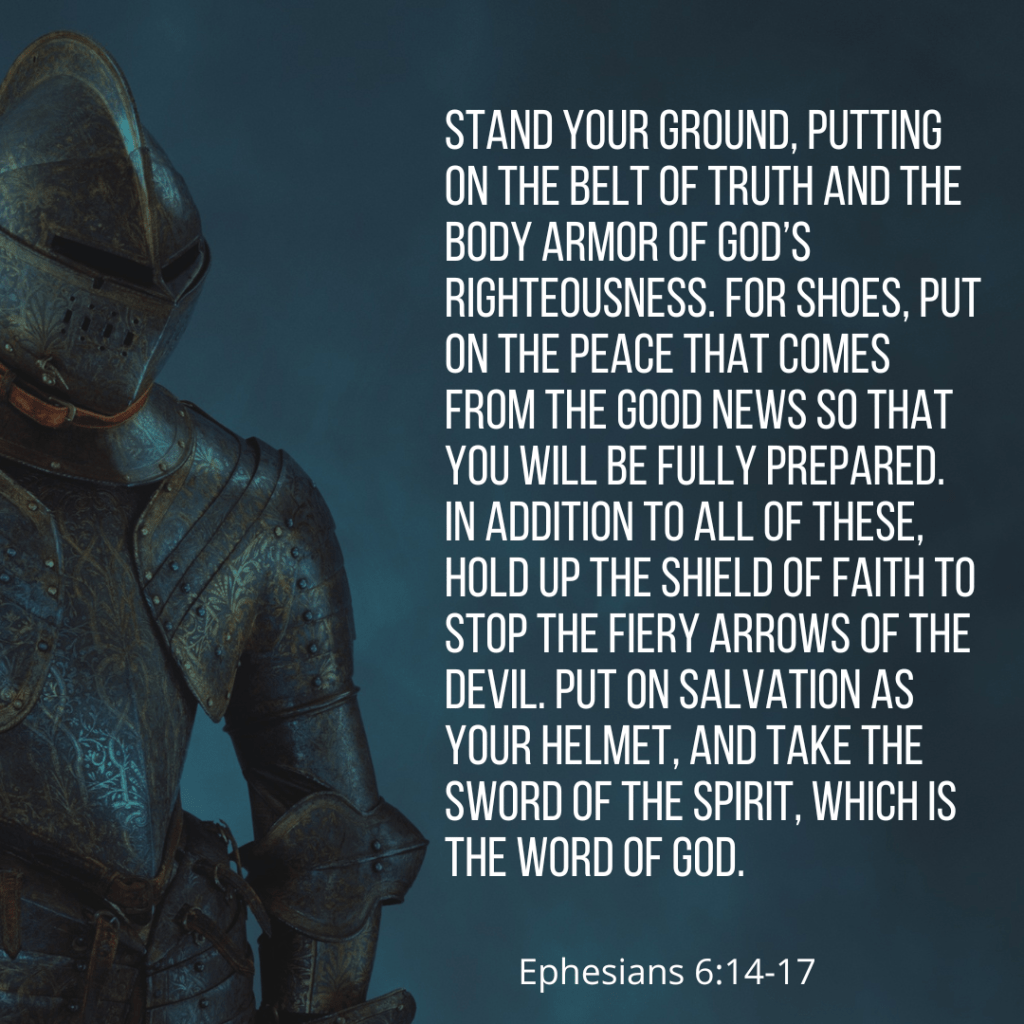
Stand your ground, putting on the belt of truth and the body armor of God’s righteousness. For shoes, put on the peace that comes from the Good News so that you will be fully prepared. In addition to all of these, hold up the shield of faith to stop the fiery arrows of the devil. Put on salvation as your helmet, and take the sword of the Spirit, which is the word of God. Ephesians 6:14-17


Oh. Paul knew who he was fighting against. He knew the enemy, because he had once been a soldier in the enemy’s camp, all the while thinking he was fighting for a righteous cause. But he had been fooled. And when his eyes were opened, he realized the error of his ways. He had not been on the winning team, even though he had fully believed he was. But once the scales fell from his eyes, he surrendered to the God who had called his name on that road to Damascus. And ever since that day, he was fighting a winning battle even when he appeared to be losing. He was, at long last, on God’s side and would fight mightily for him until his last exhale of breath. Paul knew his final victory would be to spend eternity with his Savior, so fight he must.

For we are not fighting against flesh-and-blood enemies, but against evil rulers and authorities of the unseen world, against mighty powers in this dark world, and against evil spirits in the heavenly places. Ephesians 6:12

In Paul’s letter to the church at Ephesus, he gave them basic instructions on how to stand unwavering in their faith. He taught them how to get dressed in the full armor of God every day, because that’s how he stood ready and prepared for the spiritual fight of his life. As he stood in front of the courts that day, he wore the full armor of God and was able to stand his ground speaking the truth boldly and confidently.

This body armor was not visible to the naked eye, but its effects were on full display. Those in the courtroom heard the full truth of Paul’s story, and God’s righteousness protected his heart from being wounded by sin. Paul walked into that arena in peace knowing that he was anchored and standing firm in his faith. He carried the shield of faith, so the enemy’s fiery arrows couldn’t reach him. By wearing the helmet of salvation, Paul’s every thought was protected by God. Satan’s stronghold was no threat over him. Lastly, Paul used the Word of God as a sword against Satan’s temptations. Paul was covered head to toe in God’s armor.

As believers, we too are called to be fully dressed in God’s armor every day. When we stand before our accusers for thought crimes or words of truth, we must be prepared to stand in defense of the truth. We must use every piece of God’s armor to defend our faith. Others may not see God’s armor, but as we wear it each day they will see God’s work in us as we reject Satan’s advances on our faith.

This spiritual warfare is a battle every believer faces, so we must be dressed for the occasion. As soldiers in the army of God, we must be armed at all times. No warrior enters the battle without their weapons. We can be encouraged knowing that God has provided his protection for us with this suit of armor. Those who know the strength and power of the suit will recognize its work as we publicly live out our faith.

Name Your Friends

The importance of having a network of fellow Christian friends is so obvious in today’s environment. As noted in Paul’s letter to the church in Rome, he had close ties to believers in the cities where he had preached. This wasn’t a coincidence. This was intentional, because he needed fellowship and encouragement with people who had common beliefs and interests. When he was discouraged, his friends would encourage him and vice versa. Honestly, it can be lonely to be in a church and have no friends.

Who do you turn to when you need advice? Do you turn to friends who have no biblical foundation, or do you turn to those who can lead you closer to Christ? Do your friends believe in Jesus Christ? Are they faithful followers and seeking God’s will in their lives? Will they hold you accountable when necessary, and will you do the same for them? If you want to grow your faith, look for people who are likeminded.

There are ways to grow friendships with fellow believers, and none of them can be accomplished if we sit at home crying alone. Oh. There may be times when crying alone is called for, but it won’t help develop long lasting friendships. But there are also times when you may need a shoulder to cry on, or someone may need you to shoulder their burden. Stay grounded in the Bible, so you’re well-fed enough that you can speak truth and love to others.

Attend church regularly and get involved. Consider discipling other believers in the church. If your gift is teaching, lead a Bible study. Train others to read the Bible and how to study it. Join a book study that offers sound Biblical teaching. Join the church volleyball league or any other group that interests you. Invite others to your home for dinner or coffee.

Don’t be discipled by social media influencers. They could lead you astray, if you aren’t grounded in the Word of God. As you get better acquainted with fellow believers, allow those with more biblical maturity and wisdom to mentor you. Don’t be afraid to ask someone to help guide you through a difficult phase of life. You never know when the opportunity will come full circle, and you’re on the giving end of godly advice.


For where two or three gather together as my followers, I am there among them. Matthew 18:20


Paul didn’t stay at home long. He traveled the world sharing God’s message. He had the opportunity to meet many people and witness their conversion to faith in Jesus Christ. Not only did he live and work with them, he spent months on end building into their lives. He discipled new believers, so they would have a strong faith when he wasn’t with them. He also kept up to date on the happenings of the churches and of his faithful friends. Paul was a true friend and discipler of other believers. Can I say the same of myself?

The first friend Paul mentions in a long list of friends as he closes the book of Romans is Phoebe, who lived in Cenchrea and was enroute to Rome. Perhaps she carried the letter to the Roman church. Priscilla and Aquila were close friends and fellow tent makers who had been deported by the Roman officials because they were Jews. They had landed in Corinth, Greece where Paul first met them, but were eventually able to return to Rome.

Epenetus was one of Paul’s first converts in Achaia, and he was a beloved friend. Paul mentions several other friends he identified as hard workers for the church.

Two highly respected men, Andronicus and Junia, were fellow Jews who had been in prison with Paul. They had become followers of Christ before Paul did, and were also willing to lay down their lives and livelihoods in order to spread the gospel message.

Urbanus was a co-worker in Christ, and Stachys was a dear friend. Apelles, was a good man approved by Christ. Aristobulus held church meetings in his home. Herodion was another fellow Jew. The household of Narcissus was occupied by followers of Christ. Tryphena, Tryphosa and Persis worked hard for the Lord. Rufus was chosen by the Lord to be his own, and Paul was close enough to his mother to call her his own.

Paul also lists multiple believers who met in other home churches. They too were faithful followers of his teachings of Jesus Christ. And he called them friend.

Greet Ampliatus, my dear friend in the Lord. I commend to you our sister Phoebe, who is a deacon in the church in Cenchrea. Welcome her in the Lord as one who is worthy of honor among God’s people. Help her in whatever she needs, for she has been helpful to many, and especially to me. Give my greetings to Priscilla and Aquila, my co-workers in the ministry of Christ Jesus. In fact, they once risked their lives for me. I am thankful to them, and so are all the Gentile churches. Also give my greetings to the church that meets in their home. Greet my dear friend Epenetus. He was the first person from the province of Asia to become a follower of Christ. Give my greetings to Mary, who has worked so hard for your benefit. Greet Andronicus and Junia, my fellow Jews, who were in prison with me. They are highly respected among the apostles and became followers of Christ before I did. Greet Urbanus, our co-worker in Christ, and my dear friend Stachys. Greet Apelles, a good man whom Christ approves. And give my greetings to the believers from the household of Aristobulus. Greet Herodion, my fellow Jew. Greet the Lord’s people from the household of Narcissus. Give my greetings to Tryphena and Tryphosa, the Lord’s workers, and to dear Persis, who has worked so hard for the Lord. Greet Rufus, whom the Lord picked out to be his very own; and also his dear mother, who has been a mother to me. Give my greetings to Asyncritus, Phlegon, Hermes, Patrobas, Hermas, and the brothers and sisters who meet with them. Give my greetings to Philologus, Julia, Nereus and his sister, and to Olympas and all the believers who meet with them. Romans 16:1-15

In total, Paul listed by name twenty-seven people who were his friends. He generously complimented his friends and built them up. These individuals lived notable lives and were worthy friends of this man Paul who had once hunted and imprisoned Christians. He was a trusted man, and he had developed many close friendships throughout his years of travel and ministry. These people he listed are real people. Most likely, they are commonplace people trying to earn an honest living, and they’ve accepted the call to follow the Savior that Paul preached to them.

We too can have a long list of friends if we consistently cultivate new relationships. If we read closely Paul’s descriptions of his friends, we will note that they aren’t all extremely close friends. But they are notable enough to deserve a greeting. As with Paul, not all our friendships will be extremely close. That’s not the point. While it’s important to have a close circle of trusted friends and advisors, we still need a broader range of friendships with people who have various gifts and abilities. It’s never too late to add a new name to your list.

Handmade Gods

It was a group of tradesmen who incited the riot. They made and sold silver shrines of the Greek goddess Artemis and felt their industry was being threatened. The apostle Paul had been preaching in their city for some time, and people were moving their allegiance from Artemis to worshipping God. Paul was teaching that the way to eternal life was through a life devoted to serving Jesus Christ.

As people in Ephesus were converting to this new God, they were rejecting Artemis. The tradesmen were seeing a slowdown in business. If the people didn’t worship the goddess Artemis, then they wouldn’t continue buying these silver figurines. The men would be out of business. Their livelihood would be destroyed.

These makers of silver gods knew that if enough people were convinced that these handmade statues weren’t really gods, they would be forced to close their doors. And they knew that Paul had not only persuaded many in their city to serve the One and Only God, but he had also preached the same message throughout the entire region. They weren’t necessarily upset about the message Paul was preaching. They were concerned about their economy, and they wrapped their concern in religious and patriotic messaging. He must be stopped. At all costs.

I can understand why the men were all upset. The temple to this goddess, also known as Diana, was considered to be one of the seven wonders of the world. It must have been a sight to behold. This temple was famous throughout the world. So, if someone was suddenly causing these men to lose business, of course, they would have to challenge the newcomers. A confrontation was in order. Their business was important, and no outsider could come in and ruin it for them. Absolutely not. So they took matters into their own hands.

As the men became angry at the injustice they saw happening against them and their life’s work, they began to stir up trouble. They started a riot, and crowds rushed to the amphitheater. Soon, the entire city was full of confusion. They thought they were heroes for the sake of their beliefs, but it was all a matter of saving their pride and making money.

Some people went along with the crowd just so they could be part of the crowd. They had no idea what the fuss was all about or who was even in charge of all the chaos. They just followed the crowd and did and said what they were told. They had no clue what they were fighting for or against.

About that time, serious trouble developed in Ephesus concerning the Way. It began with Demetrius, a silversmith who had a large business manufacturing silver shrines of the Greek goddess Artemis. He kept many craftsmen busy. He called them together, along with others employed in similar trades, and addressed them as follows: “Gentlemen, you know that our wealth comes from this business. But as you have seen and heard, this man Paul has persuaded many people that handmade gods aren’t really gods at all. And he’s done this not only here in Ephesus but throughout the entire province! Of course, I’m not just talking about the loss of public respect for our business. I’m also concerned that the temple of the great goddess Artemis will lose its influence and that Artemis—this magnificent goddess worshiped throughout the province of Asia and all around the world—will be robbed of her great prestige!” At this their anger boiled, and they began shouting, “Great is Artemis of the Ephesians!” Soon the whole city was filled with confusion. Everyone rushed to the amphitheater, dragging along Gaius and Aristarchus, who were Paul’s traveling companions from Macedonia. Paul wanted to go in, too, but the believers wouldn’t let him. Some of the officials of the province, friends of Paul, also sent a message to him, begging him not to risk his life by entering the amphitheater. Inside, the people were all shouting, some one thing and some another. Everything was in confusion. In fact, most of them didn’t even know why they were there. Acts of the Apostles 19:23-32


Don’t be afraid of those who want to kill your body; they cannot touch your soul. Fear only God, who can destroy both soul and body in hell. Matthew 10:28


Imagine being so good at your work that your actions could threaten to put an end to an evil industry. Imagine your words and convictions being so convincing that you could cause others to turn from serving idols to serving the living God. Imagine if that would happen today. Because we are in the same predicament today as Paul was centuries ago. The thing is. Paul didn’t set out to close down this lovely temple. His entire focus was to preach the gospel of salvation to the lost souls of Ephesus. And in doing so, the newly saved souls saw the error of their ways. And they turned from their worship of this idol that was no god at all to worshiping the One True God. They had been worshiping a manmade image that had no power at all. It couldn’t even hear their prayers.

Today we find ourselves locked in a battle not of our choosing. We see industries flooding the market with products and services that go directly against God and his creation. The creators of these products push their wares on people who either don’t know or don’t care about preserving biblical values. And those who publicly disagree are made out to be the worst of the worst. Anyone who opposes these retailers and industries may find themselves out of a job. Or worse. They may find that they’ve been blackballed and are not allowed to do business. Some have even had their bank accounts closed.

I’ve been on the fence as to whether Christians should boycott certain retailers and industries that sell products that oppose biblical teachings. It’s a decision everyone who calls themselves a follower of Christ must make. To be honest, I’ve failed in my boycott attempts. I’ve heard some Christians say they don’t even try to boycott any retailers. I’ve also read of those who are working to build a parallel economy that supports only companies that hold to biblical standards.

Just imagine with me, though. If a majority of Christ followers stopped supporting retailers and industries that were blatantly shoving anti-Christian products in our faces, an impact would be seen and felt. We’ve already seen it earlier this year when a couple of companies were expecting the applause of many when they supported specific lifestyles and life choices. The backlash has been huge and the voice of the opposition was heard loud and clear. Will it last? Only time will tell. But for a short window in time, the message on the side of the opposition was powerful.

When the public square speaks a language that Christ would oppose, shouldn’t Christians today oppose it, as well? Especially when there are other options? Truth is being challenged in every segment of society, today, so we must be on high alert at all times. We must never let our guard down to the schemes of the enemy. It’s time to consider where we will spend our hard-earned dollars.

But, at the same time, believers cannot up and remove themselves from society. Believers will remain in jobs in secular businesses. Christians will remain in public schools and liberal universities. Employees will be expected to attend trainings and workshops that are counter to their beliefs. Christians can’t just hide in a hole and ask the rest of the world to accept them. There are times and places when Christians must remove themselves from situations. Due to cultural expectations in some careers, they may have to choose an alternate career to keep their faith intact. But now is also the time to dig in our heels and spend time in prayer for those who oppose Jesus Christ. If all believers were removed from society, who would be the light in the world? Jesus hasn’t called his people home yet, so we are here to be a light in the darkness.

We should not ask, “What is wrong with the world?” for that diagnosis has already been given. Rather, we should ask, “What has happened to the salt and light?”

John Stott

On Being Thankful

The signs are everywhere. And they’ve been out for awhile now. Turkeys are available. Cranberries are in stores. Stuffing packets are on display. Pumpkin pies are on the menu. It’s Thanksgiving season. Families are making plans for the big day. So we must start being thankful for the year we’ve survived. Isn’t that what we’re being told? Eat these specific foods on the last Thursday of November and be thankful for it.

Be thankful for your family. Be thankful for your job. Be thankful for your health. Be thankful for your warm home. Be thankful for the food on your table. Be thankful for your freedom. Just be thankful.

Do we have to be reminded that we should be thankful? How do we prepare for thankfulness? What if we’ve had a rotten year? Should we still be thankful? People have lost their jobs. Many others have lost loved ones. Still others have received a devastating diagnosis or other bad news. Should they be thankful? Some people are working in stressful jobs. Others are working in jobs they hate. Some are just bored with their jobs. And many just want a job. Should they be thankful for that?

What if we just don’t feel like being thankful?

There are wars going on in different parts of the world. And our country seems determined to be involved. Inflation has been soaring for the last few years. Unemployment is making an impact on people’s lives. People complain about having to work in the office instead of remaining remote. We’re being told we’ll own nothing and be happy. Should we be thankful for that?

But now that we’ve covered the negativity, let’s reverse the conversation and look at what we do have to be thankful for.


Be thankful in all circumstances, for this is God’s will for you who belong to Christ Jesus. Always be joyful. Never stop praying. 1 Thessalonians 5:16-18


Anyone reading this woke up this morning. You’re still alive. God knows the number of your days, and your number hasn’t been called yet. You still have work to accomplish on this earth. And even if you’ve received an unnerving diagnosis or had a recent health scare, the blood is still pumping in your veins. Even if your job is in a precarious spot, you still have a job.

We celebrated the changing of the seasons. The year started with winter and moved to spring. There we saw the trees bud and flowers bloom. We planted gardens and watched the vegetables grow. We mowed the lawn. We heard the thunderstorms, felt the raindrops and saw rainbows. As summer neared its end, the leaves began to turn to beautiful golds and reds. The leaves are still dropping as cooler temperatures make their way into our days. The days of sunlight are shorter, but they’re setting the stage for the cold and snowy winter that’s right around the corner.

We have to remember that the sun rose and set every single day. And it will continue to do so. The seasons will once again change. We’ll adjust to the temperatures and conditions this winter brings. We’ll slow down and drive carefully. We’ll stay indoors if weather patterns are ferocious. And we’ll survive it. Most of us, anyway.

We’ll begin our Christmas shopping and buy way more than is necessary. We’ll squeeze in as many of the holiday dinners and celebrations that our calendar allows. We’ll complain about all the sweets that we’ll eat and still eat them, anyway. We’ll hold family members close as we remember those no longer with us. We’ll plan for future holidays together. And life will go on.

Thankfulness is an attitude of the heart. We have a choice. To be thankful or not to be thankful. Jesus told us that we would have hard times in this world. If the apostle Paul learned to be content in any and every situation, can’t we? Are we content with what we have, or do we only focus on what we don’t have? Thankfulness is a choice. Contentment is a choice.

Too often, the only things we’re thankful for are tangibles. Things we can touch and taste and feel. We focus only on our feelings and experiences. Maybe it’s time to not only consider the creation, but the Creator. The One who set the moon and stars in place also set eternity in the hearts of all mankind. We are aware that there is something more than this earthly life. Something much more. And we have our Heavenly Father to thank for that. Just as the writer of Ecclesiastes tells us that there is a time for everything, God has appointed each season of our lives. Even if that season is difficult and demanding, we can be thankful for the peace that God gives.

I have told you all this so that you may have peace in me. Here on earth you will have many trials and sorrows. But take heart, because I have overcome the world. John 16:33

I have learned how to be content with whatever I have. I know how to live on almost nothing or with everything. I have learned the secret of living in every situation, whether it is with a full stomach or empty, with plenty or little. Philippians 4:11-12

We have much to be thankful for today. Let’s celebrate the goodness of God.

The Quiet Ones

The quiet ones will go unnoticed until they have to speak up or stand up or defend themselves. Then they are suddenly put on public display. And that isn’t usually a good thing. Because when the quiet ones are suddenly in the spotlight, it means their lives or livelihoods or routines have been disrupted. It means that they have had to publicly take a stand for an issue they held close but didn’t necessarily plan to share with the general public. And now they’re exposed.

Being exposed isn’t always a bad thing. But exposure for the quiet ones is unwelcome. Unwanted. Unasked for. And the exposure may show how deep or how shallow their faith really is. So come prepared to stand tall and strong when you’re unexpectedly thrust into the spotlight. Be prepared to give an answer for the cause you’re supporting.

The quiet ones prefer to be in the background. To be unseen. Unheard. Unnoticed. Especially in a crowd. But one on one, they feel more comfortable. They may even shine. When one on one, they can let down their guard and talk about what needs talked about. But don’t ask them to speak in public. And they, most likely, will never raise their hand in a room full of people. Even if they know the answer to the question. Even if they have a question. They just won’t ask it. Because then they will be seen. And heard. And someone just might notice how awesome they are and expect them to speak up more often.


For everything there is a season, a time for every activity under heaven. A time to be quiet and a time to speak. Ecclesiastes 3:1&7b


The man who offered to bury Jesus was Joseph from the city of Arimathea. He was a member of the Sanhedrin, which was the judicial ruling body of the day. This group had unanimously voted to crucify Jesus. Since the vote was unanimous, either Joseph voted in favor of the crucifixion or he wasn’t present when the vote was taken. Perhaps he abstained from the vote. Either way, he most likely felt he had failed the Messiah. What the Sanhedrin didn’t know was that Joseph was a secret disciple of Jesus. He kept his faith quiet, because he lived in fear of the Jewish leaders he consorted with. And he alone asked to take the body of Jesus for burial. No one else asked. Not the disciples. Not the women at the crucifixion. No one else asked to bury Jesus’ body. Only this one secret disciple.

Another man named Nicodemus helped Joseph bury the body of Jesus. Nicodemus was a Pharisee, and he was also a member of the Sanhedrin. He had once met Jesus face to face under the cover of darkness. He had questions about who Jesus was. Perhaps he was asking the questions out of personal interest, or perhaps he had been sent by the Sanhedrin to learn more about this man they so hated. But on the evening, as others were preparing for the Sabbath, these two men brought spices and linen and prepared the body of their beloved Savior for burial. These two men who never publicly spoke of their faith selflessly performed one final public act for their Lord.

Afterward Joseph of Arimathea, who had been a secret disciple of Jesus (because he feared the Jewish leaders), asked Pilate for permission to take down Jesus’ body. When Pilate gave permission, Joseph came and took the body away. With him came Nicodemus, the man who had come to Jesus at night. He brought about seventy-five pounds of perfumed ointment made from myrrh and aloes. Following Jewish burial custom, they wrapped Jesus’ body with the spices in long sheets of linen cloth. John 19:38-40

These two men, Joseph and Nicodemus, held powerful positions. They were both members of the ruling group. They were wealthy and influential men of their day. They were not strangers to each other. But they each lived in private fear of public humiliation. They kept their faith quiet. But in a moment of faithfulness, they buried the body of their Savior. Anyone who hated Jesus and despised what he stood for would have cared less what happened to the dead body of a man who called himself the Son of God. These two men acted in reverent love for the One who would rise from the dead on the first day of the new week. They risked everything. Their lives. Their families. Their careers. All for the act of removing the body of Jesus Christ from the cross and burying him in a tomb. There is no record in the Bible of what happened to these two men afterwards, but historical documents show that they paid a huge price for this act of love.

Many people today openly share their thoughts for or against hot button issues of the day. And, somehow, it’s assumed that the loudest voices are the most popular. Not necessarily. Each of us may be known as one who is quiet about our faith or our convictions on current events. We don’t always have to speak up about our differences, unless God leads us to share. If we know that our differences will only cause friction, we have to ask ourselves if it’s the right time to speak up. Other times, as directed by God, we will perform acts of servanthood to others.

Our time of service or our words of faith can be far more reaching than we may ever know. Our faithfulness is the key. We must always be ready to give an answer for our faith when asked. We must perform acts of love and selflessness when called on. Oh. These words of faith and these acts of love may be misinterpreted, and we may be treated unfairly for them. But regardless of the outcome or the outcry against us, we must stand strong in our faith. And we must be prepared to risk everything by speaking or acting for an unpopular faith or belief.

Interceding

Years ago, my dad was in the hospital for emergency surgery. The poisonous infection that spilled from his gall bladder was endangering his life. He lay in that hospital bed for a few days, weakened by the infection and recovering from the surgery. He told us later that there were moments where he was too sick to pray for himself. He needed the prayers of others to get him through those difficult days. Not only did my dad need the prayers of righteous people, but he needed the intervention of the medical team. The prayers worked. And the surgery worked. My dad made a full recovery. He couldn’t have survived on his own. He needed an physical intervention to save his life.

Job lived a good life. He was considered to be the wealthiest man of his day. Satan knew this about him, and he accused God of putting a hedge of protection around Job. And he asked the unmentionable. Satan asked God if he could test Job to see if his faith in God would waver. And God said ok. But God set boundaries. Satan could not kill Job. You may not call this an intervention or intercession, but God advocated for Job even though he allowed a time of great testing to come over the man.

There once was a man named Job who lived in the land of Uz. He was blameless—a man of complete integrity. He feared God and stayed away from evil. He owned 7,000 sheep, 3,000 camels, 500 teams of oxen, and 500 female donkeys. He also had many servants. He was, in fact, the richest person in that entire area. He had seven sons and three daughters. Job 1:1-3


Therefore he is able, once and forever, to save those who come to God through him. He lives forever to intercede with God on their behalf. Hebrews 7:25


When Jesus sat down to eat the Passover meal with his disciples, he knew the suffering that was just ahead for him. Later that night, he would be brought to trial. He spent his last moments with his disciples preparing them for what they didn’t yet understand. He shared from his heart and let them know that they, too, would be the subject of much suffering. But before that happened, they would all desert him. And Peter claimed that he was ready to die for his Master. Yet, Jesus knew the lies Peter would tell that very night. He would deny even knowing Jesus. Not once. Not twice. But three times.

Jesus told Peter how Satan had asked to sift him like wheat. And Jesus, in love and compassion, fought for this man who had thrown down the fishing net to follow him. He pleaded with his Father to keep Peter within the fold and save him from the enemy. Peter and the others didn’t know that Jesus would willingly lay down his life for them the very next day. And without Jesus’ teachings and intercession for his disciples, they all would have failed the mission he set before them.

“Simon, Simon, Satan has asked to sift each of you like wheat. But I have pleaded in prayer for you, Simon, that your faith should not fail. So when you have repented and turned to me again, strengthen your brothers.” Luke 22:31-32

And He’s ever interceding
to the Father for His children;
Yes, He’s ever interceding
to the Father for His own;
Through Him you can reach the Father,
So, bring Him all your heavy burdens;
Yes, for you He’s interceding,
So, come boldly to the throne.

The Speers

But why? Why, we ask, would Jesus pray for us? Why would he defend us and intercede? Why would he step in the way of Satan running over our lives? Because, we who are children of God, are destined to spend eternity with our Father. He doesn’t want any of us to stray, so he fights for us. We are worth it to him. Jesus didn’t just die on that cross for us and then forget about us. He pleads to his Father to save us from the evil one. Because the evil one is out for our souls. And he must ask permission to test us.

Then I heard a loud voice shouting across the heavens, “It has come at last— salvation and power and the Kingdom of our God, and the authority of his Christ. For the accuser of our brothers and sisters has been thrown down to earth— the one who accuses them before our God day and night. Revelation 12:10

God hates sin. It never becomes a trivial matter to him. He sent his only Son to die for the sins of all mankind, so why would he ever turn aside from pleas to keep us in his favor? His Son was the sacrifice for our sins, so of course, he’ll continue pleading for our eternal safety. He wants to spend eternity with us as much as we should want it. He fights for us.

We have much to be thankful for when we consider the gift of salvation that is made available to us. We also have a constant Defender who is fighting for us in all circumstances. He will not let up on keeping us under his protecting wings. Jesus Christ fights in our defense. He prays for us. He is always working for us. We aren’t in the fight alone.

In Christ alone my hope is found,
He is my light, my strength, my song;
This Cornerstone, this solid Ground,
Firm through the fiercest drought and storm.
What heights of love, what depths of peace,
When fears are stilled, when strivings cease!
My Comforter, my All in All,
Here in the love of Christ I stand.

Stuart Townend & Keith Getty

Business As Usual

God promised Abraham that he would be the father of many nations. From that moment forward, the Israelites had time to prepare for the coming Messiah. Oh. They believed he would arrive shortly, but they didn’t know when or how. And they literally had centuries to prepare for him. They just didn’t know it. And with each passing decade, the anticipation should have been mounting. The clock was ticking down to his arrival. They still believed the Messiah would arrive, but there wasn’t such a rush to prepare for him. After a while, they lost the sense of urgency. They didn’t realize the upheaval his presence would cause for them. They really didn’t know what to expect, so they lived their lives without preparing to make room for him. They lived as if they didn’t believe God’s promise.

When the Messiah actually arrived, most seemed to be caught off guard. He was a baby. And his so-called parents were ordinary people. How could a Messiah come from such a town as Nazareth? And who in Nazareth and the surrounding area would listen to him? Who would respect his message? They wanted a king. They wanted the whole royal setting with pomp and circumstance. And they got nothing like that. In fact. His coming and his life were in total opposition to the royal way of life. He was born in a space set up for barnyard animals. His family had to flee the country under cover of night because of death threats. He was a carpenter. He worked with his hands. He got dirty. He was poor. And he looked so ordinary.

We, too, have received a promise that the Son of God will take all his children home. He will return, and we should be faithfully preparing for that day. We’re waiting for what is known as the rapture. At a time known only to God, everyone who has surrendered their lives to him will be taken to be with their Lord for eternity. And by eternity, I mean forever. Life on this earth as we know it will be over.

For the Lord himself will come down from heaven with a commanding shout, with the voice of the archangel, and with the trumpet call of God. First, the believers who have died will rise from their graves. Then, together with them, we who are still alive and remain on the earth will be caught up in the clouds to meet the Lord in the air. Then we will be with the Lord forever. So encourage each other with these words. 1 Thessalonians 4:16-18


However, no one knows the day or hour when these things will happen, not even the angels in heaven or the Son himself. Only the Father knows. And since you don’t know when that time will come, be on guard! Stay alert! Mark 13:32-33


But there is a problem. Many will be left behind. Many have not bowed their knee to the Savior of the world. Many are living as if their life is all that matters. They either don’t know, don’t care or don’t understand that their eternity is at stake. And once they’re in eternity, there’s no do over. And if they’re not in heaven, then they’re lost. Forever. Think about it.

We are living as if we have all the time in the world. We are living as if there will always be a tomorrow. We’re living as if there will always be time to make amends. To start doing the right thing. To repent. To become a Christian. But time is short. And the signs are all around us. We just aren’t paying attention. We aren’t looking beyond today, because today seems to be enough. We are too self-sufficient. Too self-reliant. Too selfish to think beyond our wants. We aren’t looking for a Savior. And because of that, many will be left behind to face the growing Satanic assault.

When the rapture happens, many will be caught unaware. People will be surprised and alarmed. Many will realize that they’ve bought into a lie that this day would never happen, and now there will be a price to pay. They will then know that they have squandered so much time. So much wasted time has been spent satisfying themselves rather than obeying God. And their life is about to get much more worse than they could ever imagine.

When God told Noah to build an ark because a flood was coming, Noah got to work immediately. He had no idea when the rains would start. He just knew they would. Others laughed at him. They thought he was crazy. But when the rains began, you can bet they were pounding on that boat hoping to be rescued. It was too late.

“When the Son of Man returns, it will be like it was in Noah’s day. In those days, the people enjoyed banquets and parties and weddings right up to the time Noah entered his boat and the flood came and destroyed them all. “And the world will be as it was in the days of Lot. People went about their daily business—eating and drinking, buying and selling, farming and building— until the morning Lot left Sodom. Then fire and burning sulfur rained down from heaven and destroyed them all. Yes, it will be ‘business as usual’ right up to the day when the Son of Man is revealed. On that day a person out on the deck of a roof must not go down into the house to pack. A person out in the field must not return home. Remember what happened to Lot’s wife! If you cling to your life, you will lose it, and if you let your life go, you will save it. That night two people will be asleep in one bed; one will be taken, the other left. Two women will be grinding flour together at the mill; one will be taken, the other left. ” Luke 17:26-35

No one knows the day and hour that this life changing event will happen. But anyone who believes the Bible is true knows this to be a fact. Only God knows the appointed time for this earth shattering event to take place. Our job is to live prepared at all times. Sure. We can go about our business as usual, but our spiritual business must be kept in order. We must be fully surrendered and obedient to God’s call, because we never know when our name will be called. Be on guard! Stay alert! Be ready!

We Are Not All Right

He is the mayor of a large liberal city. During his campaign, he said he wanted to improve public safety, but his city is overrun with crime. He said he wanted to build a stronger, healthier city, and now the place is being swarmed with illegal immigrants brought in from the border. He said he wanted to reduce inequality, yet he now says the asylum seeker crisis will destroy his city. After the Hamas attack on Israel, he says enough is enough. He condemns the antisemitism that is being spread by this terrorist group, and he stands strong with Israel.

He has said that we are not all right. And he’s right. We are not all right in this world. The world seems to be collapsing in on itself with no plan for course correction. Oh. We can’t move back the hands of time to a kinder, gentler day. We just can’t. Time continues to move forward even during days of unnecessary evil. It’s just the way life goes. One second becomes two and so on. The peace we once had is gone. The safety we once felt is gone. The time to be complacent is long gone. The courage we never knew we needed is now badly needed.

We can’t return to the good ole’ days, because today is all we have. Tomorrow is not a guarantee, and yesterday is spent. We’re told we need safe spaces where we won’t feel threatened. But what exactly is a safe space, and who is it safe for and safe from what?

In the New Testament, Paul warned his traveling companion, Timothy, that times will be difficult in the last days. And they thought they were living in the last days. Oh. If only they could see us now.

You should know this, Timothy, that in the last days there will be very difficult times. For people will love only themselves and their money. They will be boastful and proud, scoffing at God, disobedient to their parents, and ungrateful. They will consider nothing sacred. They will be unloving and unforgiving; they will slander others and have no self-control. They will be cruel and hate what is good. They will betray their friends, be reckless, be puffed up with pride, and love pleasure rather than God. They will act religious, but they will reject the power that could make them godly. Stay away from people like that! 2 Timothy 3:1-5

We’re told that in the last days, there will be wars and rumors of wars. Nations will go to war. There will be famine and earthquakes. There will be persecution of believers. There will be false teachers and false prophets.

Jesus told them, “Don’t let anyone mislead you, for many will come in my name, claiming, ‘I am the Messiah.’ They will deceive many. And you will hear of wars and threats of wars, but don’t panic. Yes, these things must take place, but the end won’t follow immediately. Nation will go to war against nation, and kingdom against kingdom. There will be famines and earthquakes in many parts of the world. But all this is only the first of the birth pains, with more to come. “Then you will be arrested, persecuted, and killed. You will be hated all over the world because you are my followers. And many will turn away from me and betray and hate each other. And many false prophets will appear and will deceive many people. Sin will be rampant everywhere, and the love of many will grow cold. But the one who endures to the end will be saved. And the Good News about the Kingdom will be preached throughout the whole world, so that all nations will hear it; and then the end will come. Matthew 24:4-14


Never stop praying. Be thankful in all circumstances, for this is God’s will for you who belong to Christ Jesus. 1 Thessalonians 5:17-18


There were courageous believers in the Bible who lived through harrowing times. They were persecuted. Their faith was challenged. Their lives were threatened. Things were not all right in their world. Yet they held firm to the conviction that they would serve God regardless of the cost. Two people I think of time and again are Daniel and Esther. Their faithfulness to obeying God’s leading and standing strong in their faith during challenging cultural times is a reminder that my faith doesn’t have to waver in today’s cultural crisis. I too can live in obedience to God’s commands without defiling my relationship with him, even when culture today is pushing in direct opposition to biblical truths.

Daniel lived over sixty years in a foreign land. Taken as an exile as a teenager to Babylon, he never returned home to Israel. His name was forcibly changed to represent a false god. He was indoctrinated with mystical and ungodly teachings. He worked for an employer hostile to his faith during his entire career. He achieved honors and promotions in his career all the while serving kings who disregarded God as the One True God. Yet every time he was pushed to defile his faith in God, he refused. He stood strong in his convictions, regardless of the cost. He never lost faith. He was faithful throughout his life, enduring much loss. And he was highly respected by the kings he worked with throughout his adult life. God honored Daniel’s faithfulness, yet Daniel never lived as a free man.

Esther was a young Jewish woman born into exile in the Persian city of Susa. When the Persian king, Ahasuerus, banished Queen Vashti for refusing to entertain his guests, he began the hunt for her replacement. In a sweep of all the young virgin women, Esther was placed in his court. Each candidate was to spend one night with the king. The one he favored would become queen. Esther, giving up all her hopes and dreams for the future, was forced into a life not of her choosing. Yet God saw her and placed her in the king’s court where she was crowned queen. She found favor in the king’s eyes, and yet the King of Kings favored her and heard her prayers. Her people were not all right. Their lives were being threatened, but through a series of events Queen Esther was able to save her Jewish people from annihilation.

As a nation, we are not all right. We have open borders where young military age men are streaming into this country unchecked and unvetted. We have elderly leaders in top political positions who are unfit for office. We have a presidential candidate, a former head of state, who could end up in prison. Our country is funding a war that is none of our business. Corruption runs deep in the deep state, but it’s a risky business to bring it to an end. Something is very wrong.

We’ve replaced God in schools with extreme ideologies that corrupt young minds. We now push equity over equality. We allow unqualified candidates to edge out the more qualified ones for jobs, and then we are confused when the work suffers. Something is very wrong.

We’re forced to consider everyone’s selected pronouns. We scream in protest when women’s feminine products are removed from men’s restrooms. We applaud when men win women’s sports events and beauty contests. We name a biological man as woman of the year. We’re extremely concerned about the atrocities being exacted upon innocent lives in Israel and Palestine. We hear of babies being beheaded in the Middle East, all the while smiling on the beheading and dismembering of innocent unborn babies in this country. We are not all right.

Our country is focused on issues that have turned our culture into an unrecognizable mess. We’ve been heading down a dark abyss for decades, and we’ve lost our way. Our country is in chaos, and it doesn’t have to be this way. The powers that be have a plan in place to destabilize the country and keep us in a constant state of chaos. We are not all right.

We are not all right. That is definitely true. Is it too late to turn this nation back to God? Can we find our way back? That is the question we are facing. Can this country be turned around to afford more people time to answer the call to surrender their lives and their wills to Jesus Christ? Because that is our only hope. But it’s not just about this great nation we live in. Our country is not the entire world, and evil abounds in every nook and cranny of the globe. Evil and corruption are found in the elite board rooms all the way down to the dirt floor hovels all over the world.

It appears that we’re moving closer and closer to the time Jesus Christ will meet his followers in the sky and take them to heaven with him. But until that time comes, Satan will continue to expand his reach into every area of life. God is allowing Satan to exert more and more power in the world. Our hope is to pray for God to extend his mercy to us and delay his judgment on many unsuspecting souls. It’s time to pray without ceasing, because the day is coming when Satan will have full control for a short time. Then Jesus will soundly defeat him in record time.

Then the man of lawlessness will be revealed, but the Lord Jesus will slay him with the breath of his mouth and destroy him by the splendor of his coming. 2 Thessalonians 2:8

No. We are not all right. But God can make all things right in our hearts if we bow before him and confess him as Lord and Savior of our lives. Then, regardless of our circumstances, everything is all right.

And the one sitting on the throne said, “Look, I am making everything new!” Revelation 21:5

Small Beginnings

There they were.  All five thousand of them who had come to hear the man named Jesus teach.  What they didn’t know was that he was trying to find some alone time, but the people kept searching him out.  And he didn’t disappoint.  He didn’t tell them to wait until he had replenished his need for solitude.  He didn’t tell them to go home and come back tomorrow.  No.  He sat down and taught them the words of his Father. 

The meeting was likely impromptu.  It wasn’t a planned event.  The people would seek him out in droves, especially after he began performing miracles.  Aside from wanting to see a miracle firsthand, these people were eager to know what it was about him that was so different. They had never heard anyone speak as he did. They dropped everything to sit and listen to him speak for hours on end.  They would swarm him and hope to hear his latest teachings.  Oh.  They would come unprepared, bringing nothing to eat or drink.  They thirsted for truth, not physical comfort.

But then.  They had been sitting there for hours.  Listening to this man who called himself the Son of God.  And they began to get hungry.  Stomachs growled.  Children grew restless.  Adults became weak.  But it wasn’t a planned event, so there were no buffet lines or snack machines.  There was no bottled water or fast food.  And there was no budget to feed such a large crowd.  There was no plan.  At all. But Jesus knew the people needed to be fed. So he mentioned the need to Philip, because he wanted to test this disciple.

There was one young boy in the crowd who must have come alone.  No word is written about his parents.  But someone, perhaps his mother, thought to pack him a small lunch.  Someone knew he would become hungry and need to be fed.  So he carried his lunch with him.  Not thinking of feeding anyone but himself, he may have sat alone listening to the Great Teacher.

The young boy was most likely very poor. It was obvious because his lunch consisted of barley bread and fish. It was the barley bread that gave it away. Only poor people used cheap barley instead of wheat to make their bread. But if five thousand people are hungry, will they mind eating cheap bread?


Do not despise these small beginnings, for the Lord rejoices to see the work begin.  Zechariah 4:10


What that child didn’t know when he left home that day was what a stir his cheap lunch would cause. He didn’t know that the story of his lunch would be told until kingdom come. Oh. It wasn’t as if he planned it. But his lunch made history. A miracle was performed through his small offering. He gave what he had, and everyone ate until they were filled. There were twelve baskets of food left over. The story of his small offering is a clear example of how God works in mysterious ways to care for his people.

Oh. If only we would be willing to offer up what little we have. We don’t have to offer the most expensive items or designer name brands. We offer what we have, even if it is a sacrifice. Even if our offering is from the dollar store, God can use a gift given from a willing heart. If we serve hot dogs and chips to guests, God will be in the room with us if we’re serving others in his name. We don’t have to serve steak and lobster in order to please God. It isn’t the offering we give, but it’s the attitude of giving that God sees.

I think of the young widow who dropped two small coins in the offering. While the wealthy made a big show of placing their large offerings in the basket, she quietly gave all she had with the hope that no one saw her small gift. It might have been a sorry gift to some, but it was all she had to offer. And she didn’t hesitate. I would love to know how her faithfulness was rewarded. Not that we should expect a tangible reward for our faithfulness, but Jesus was standing there watching the crowd and he saw her gift. He explained to his disciples that while the wealthy gave a tiny share of their surplus, she gave all she had.

While Jesus was in the Temple, he watched the rich people dropping their gifts in the collection box. Then a poor widow came by and dropped in two small coins. “I tell you the truth,” Jesus said, “this poor widow has given more than all the rest of them. For they have given a tiny part of their surplus, but she, poor as she is, has given everything she has.” Luke 21:1-4

When a college graduate begins their career, they shouldn’t expect to start out as CEO. They start at the bottom and work their way up the ladder, if they have the right opportunities and skills. When a pastor plants a new church, he doesn’t start with a large congregation. He may start with only a handful of people and a low budget. Then he will see growth from his sacrifice, faithfulness and prayers. A new business starts small, because no business is ever planted as a Fortune 500 company. It takes years of effort and hard work to reach the pinnacle of what some call success.

I read recently of an older woman who went out in public in her best clothes. Others laughed at her, because of her cheap, worn outfit. Hearing their laughter, she bent with shame at their words. Her best was a laughable offense in their eyes, but it was all she had. At times, others may smirk at our small offering, as if it’s worthless. Other times, we may be the one who laughs behind the back of another at their small beginning. Shame on us.

We may think we have nothing to offer. Our talents seem unidentifiable. Our gifts seem indistinguishable. Our stewardship seems insignificant. But if we give of our best, God knows. We may only be able to give small gifts, but when we give them cheerfully and willfully, it’s the attitude that matters.

Don’t give reluctantly or in response to pressure. For God loves a person who gives cheerfully. 2 Corinthians 9:7