I follow a page on social media that shares rare and unusual words, along with their definitions. Recently, one of the posts listed a few rare words that have beautiful meanings. One word caught my attention, and not in a good way.
Pulchritudinous: beautiful
How could such an ugly sounding word speak beauty to someone? And, how can beauty be described with a word that sounds so repulsive? Who would ever use that word in a sentence? I have to admit. I had never even heard the word, and I’m sorry now that I have. It sounds like something you want to avoid, yet it means something you want to be near. It’s an oxymoron of sorts.
I asked AI about this ugly word. Here’s what I learned. The word pulchritudinous is on the list of the ugliest words in the English language. Taken from the Latin word pulcher, it’s a word that fails to be what it describes. It does sound rather putrid. It’s not a word that flows smoothly off the tongue, and just imagine using it in a sentence in front of strangers. Would they think you were haughty? Or, just plain ridiculous?
This ugly sounding word got me to thinking. Do I ever speak words that sound harsh or insensitive, when I actually mean something quite different? Do my words sound like death when I was offering life to the one hearing what I have to say? Is that even possible?
Is there ever a time when horrible sounding words actually speak life to the hearer?
The phrase “say what you mean, and mean what you say” comes to mind. I agree with that statement, but I find that the delivery of words has an equal amount of weight as the words themselves. A parent may sound harsh when correcting their child, but their intent is to instruct the child to do better. The punishment may be harsh, but the intended outcome is correct behavior.
An employer may have to discipline an employee over some grievous activity, and that is in order. Church leaders may have to discipline a church member if they’re blatantly and unrepentantly disregarding God’s commands. There are appropriate times for harsh words to be spoken, but they must be delivered with kindness. It is possible to do, all the while being difficult.
When Jesus drove the money changers out of the temple, he was not being kind. He was being severe with them and wasn’t afraid to do so. He was letting the Pharisees and money changers know that they had stepped over the line in their use of the temple. He would not allow that to continue under his watch.
Note then the kindness and the severity of God: severity toward those who have fallen, but God’s kindness to you, provided you continue in his kindness. Otherwise you too will be cut off. Romans 11:22
Who we are as people is much more visible to others than we may realize, and it is all displayed in the kinds of words we speak. ~David Gibson, The Undivided Life
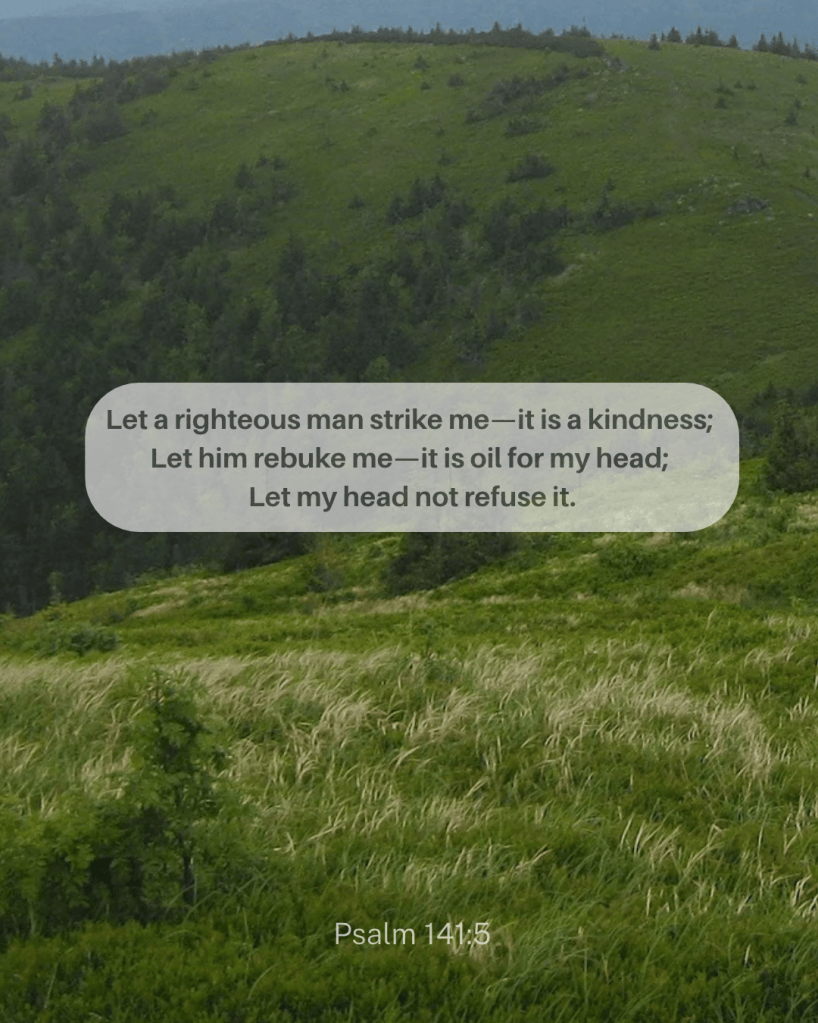
Let a righteous man strike me—it is a kindness; let him rebuke me—it is oil for my head; let my head not refuse it. Psalm 141:5
Dr. John Piper says there is a sort of kindness that is hard as nails and tough as leather. And there are times when tough love is appropriate. Tough love does not affirm ungodly choices that someone else makes. When we read the Old Testament, we find many times God’s love and kindness were tested by the Israelites. God did not withhold his love, but he also didn’t withhold his judgment. His punishment was often very severe, but his love was eternal. He wanted to have a relationship with his chosen people on his terms, not on theirs. And he would not stand for them serving other gods. He was their one and only God.
Also in the Old Testament, Joseph tested his brothers who didn’t recognize him. Years earlier, they had sold him into slavery to Egyptian traders. He became governor of Egypt, second in command to the Pharoah. When famine hit all the surrounding countries, his brothers came to buy grain. They didn’t recognize Joseph, but he recognized them. He spoke harshly to them to test them, before he revealed his true identity.
You can read the full story of Joseph and his family in Genesis 37, 39-45. It’s a long story, but well worth the read.
King David committed adultery with Bathsheeba, who was married to the warrior Uriah. When David learned she was pregnant, he made sure Uriah was killed in battle. He thought he covered up his sin. He did not. One does not cover their tracks in front of an Almighty God who sees and knows everything. God sent the prophet Nathan to confront David with his sin once the child was born. It was a humbling experience for a mighty king. In his repentance, David was forgiven.
You can read the story of David and Bathsheeba in 2 Samuel 11-12:23.
As followers of Christ, we sometimes need a good pruning. In our Christian walk, there are times our old desires and actions need to be fully lopped off in order for us to grow in our faith. Other times, our old ways are pruned and cleaned up so our faith can thrive. The Holy Spirit works in us to keep us walking in the path of Christlikeness, and his pruning will align our will with God’s if we’re obedient. There are sometimes painful lessons we must learn, but they’re necessary in order for us to stay on the path of holiness.
Every branch in me that does not bear fruit he takes away, and every branch that does bear fruit he prunes, that it may bear more fruit. John 15:2
By his own Word, Jesus, God made everything. With his own words, he called the universe into existence, and so God has made a world in which words matter. Words can inflict the worst of evils or bestow the best of blessings. ~David Gibson, The Undivided Life
Faithful are the wounds of a friend; profuse are the kisses of an enemy. Proverbs 27:6
We can choose to be kind, even when the moment calls for harsh words of truth. With the goal of loving restoration, the one doing the confronting should be willing to humbly confront the one in the wrong. As uncomfortable as it may be, truth matters. Words matter. And kindness matters.