
The apostle Paul wrote a personal letter to a fellow believer and friend, Philemon. Now Philemon was a slave owner in the times of the early church. Paul also mentioned Apphia and Archippus in the letter. Scholars have noted that these two were most likely the wife and son of Philemon. This family had a slave named Onesimus, who had run away from their home. This, of course, was very upsetting to the family for various reasons. And somehow in running from his master, Onesimus found his way to Paul. And Paul learned to love this runaway slave as his own son. Somewhere in his life, Onesimus had become a follower of Christ. Was it because of his master’s Christian witness, or was it from Paul’s?
But matters needed to be settled between the slave and his master. Onesimus couldn’t keep running forever, so Paul wrote to his friend Philemon with the hopes of making amends for this errant slave. No one knows why Onesimus ran away. Was he mistreated? Or misunderstood? Was he dishonest or difficult to work with? It could have been that he just longed for freedom. But in those days, punishment for a runaway slave was not pleasant.
Onesimus had wronged his master. But Philemon was known as a kind man. His reputation was one of kindness. So he must have been disappointed, to put it mildly, to find his slave had betrayed his trust. And now his friend Paul was asking him to accept Onesimus back in the spirit of kindness. Could he make amends with the one who had wronged him? Would he?
I have to ask myself how I would treat someone who had publicly wronged me. Because it wasn’t as if losing a slave was a private matter. Word gets around when a slave goes missing. Some owners might bend to threatening their slaves in case they get the same idea and there’s a made rush for freedom.
What is the proper thing to do if the slave comes back seeking restitution?
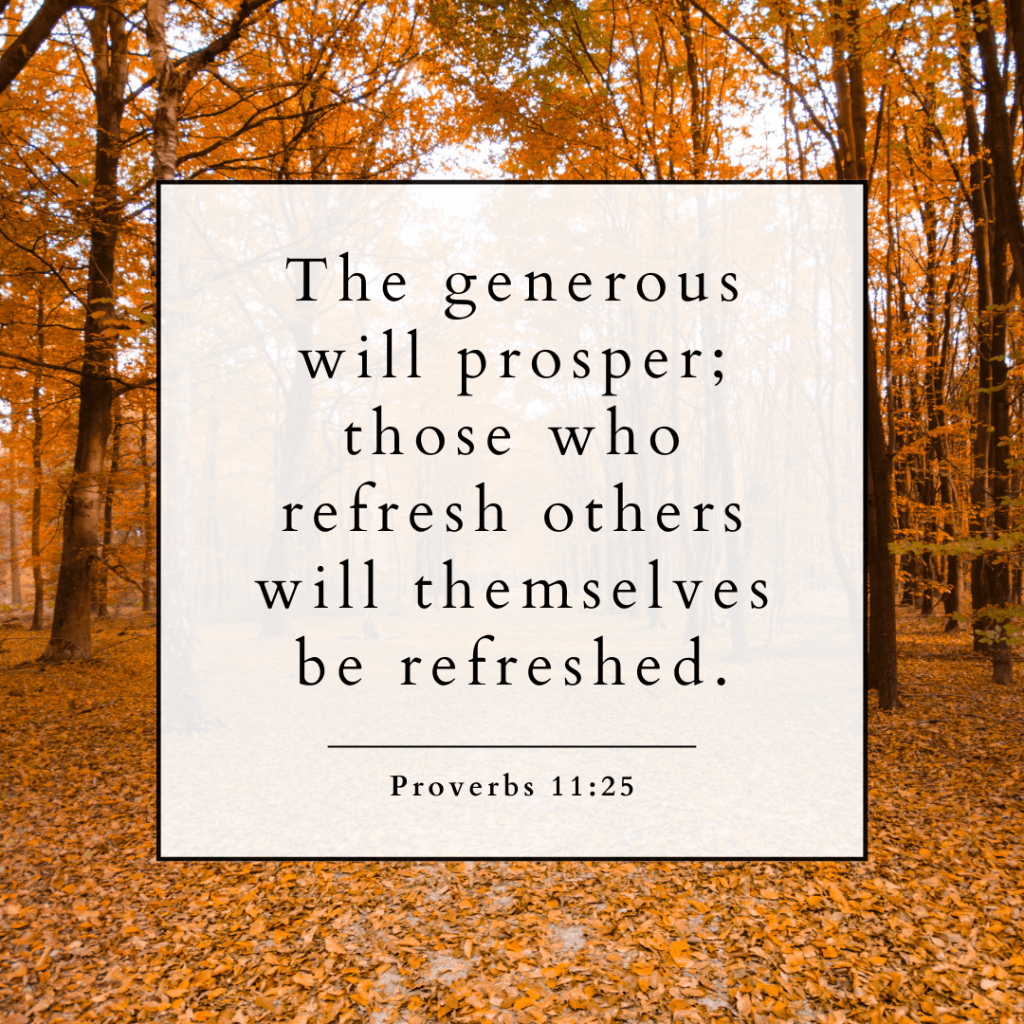
The generous will prosper; those who refresh others will themselves be refreshed. Proverbs 11:25
Am I known for kindness? Do I always offer the hand of kindness when I have been wronged? Would my first instinct be to play the victim and then speak ill of the offender? Or would I instead speak of their positive traits that I appreciate? Would I dredge up all the inconsistencies I’ve seen in their life or share the good I witnessed? Would I keep my thoughts to myself or would I share every dirty secret I know about the traitor?
When I am remembered by others, what do they remember? Is it my sharp tongue? My art of putting others in their place? Or am I fondly remembered for my kindness? Do others consider the kind deeds I’ve performed in their time of need? Do they know of my goodness and not only my badness? Not that my reputation is of necessity, but as a known follower of Christ, how do I represent the one I claim to represent?
The thing is. Paul expected Philemon to kindly welcome Onesimus back home. Oh. Maybe there would be restrictions on his freedom. There would most likely be a time of testing. But it was clear that Paul’s expectation was that Onesimus would be welcomed with outstretched arms. Philemon’s reputation preceded him, as he was known for his deep faith in Christ. Paul knew Philemon’s faith was proven and true and that it had produced in him the fruit of the Spirit, one of which is kindness. Philemon bore the image of Christ. And didn’t Christ tell us to forgive others as we have been forgiven for our sins? So wouldn’t it be natural to expect Philemon to forgive his disobedient servant? He had shown kindness to others in times past. Why not now?
Oh. No one said it would be easy to forgive a wayward slave. But as one whose faith in Christ had matured, Philemon knew the value of forgiveness. He knew the saving work of grace in his life, so why wouldn’t he extend it to others? As the Holy Spirit had worked to trim the unproductive vines in his life, he had become a solid example of Christlikeness to others. Now he must act on it.
But the Holy Spirit produces this kind of fruit in our lives: love, joy, peace, patience, kindness, goodness, faithfulness, gentleness, and self-control. There is no law against these things! Those who belong to Christ Jesus have nailed the passions and desires of their sinful nature to his cross and crucified them there. Since we are living by the Spirit, let us follow the Spirit’s leading in every part of our lives. Let us not become conceited, or provoke one another, or be jealous of one another. Galatians 5:22-26
Are the fruits of my faith and love on display for others to see? Do others know that I’ll treat someone who’s wronged me with forgiveness? Or, do they wonder how I’ll handle this obstacle in my life? Am I consistent in my faith, or do I act on my feelings and fears? Do I hold a grudge, or do I hold my faith strongly? No one knows our hearts but God, until we act publicly on our heart’s leanings. Then our true nature is on display for all to see.
And I am praying that you will put into action the generosity that comes from your faith as you understand and experience all the good things we have in Christ. Your love has given me much joy and comfort, my brother, for your kindness has often refreshed the hearts of God’s people. Philemon 1:6-7
Hearts are unknown but to God, till overt acts discover them. Matthew Henry
 Mercy for the Day