
Self Control: The control of oneself; the ability to master one’s desires and impulses.
Self Entitlement: A mentality where an individual believes they inherently deserve special treatment, privileges, or favorable outcomes simply because of who they are, without having earned them through merit, effort or contribution.
I recently read an interesting article about self control. It told the story of a traveler on a train from London to Paris who encountered a group of young women traveling the same route. Of the seventy-two passengers on the train, only the six young women were noisy. In fact, they were talking and laughing loudly in a way that showed their self importance. They showed no regard for anyone else’s comfort on that train. Until the writer of the article approached them, that is. When called out for the rude behavior, one young woman answered with an attitude of belligerence. Yet, another woman in the group answered apologetically and said she didn’t realize they were too loud.
Six loud voices against sixty-six quiet people. What would you do if you were in the quiet group? Would you have dared to speak up? If you did, would you have been kind or demanding? The sentence in the article that impressed me was “I spoke much more mildly than my inner thoughts might have prompted me to speak.” The one who confronted the young women showed restraint in his approach to an awkward situation. He made a judgment call to kindly point out the trouble the group was causing without causing trouble himself. That in itself is an act worth noting.
Read the article here.
This story got me thinking about the way I treat others. Do I always think I’m in the right when someone challenges my position? Do I struggle to see their point of view? Do I assert my “rights” and scoff unapologetically at their insensitivities? Do I think I’m always right? Does my conscience ever challenge my sense of entitlement? Does my conscience still work? Do I conduct myself in a thoughtless manner that leaves others offended?
And if someone dares to correct me, how do I respond? Do I act or speak aggressively, knowing that one of my flaws has been discovered? Do I present an attitude of entitlement? Or, do I quietly and kindly consider the words that were spoken in a challenging moment? Do I thank them for their honest assessment of my untoward behavior? And then change that behavior?
Set a guard, O Lord, over my mouth; keep watch over the door of my lips! Do not let my heart incline to any evil, to busy myself with wicked deeds in company with men who work iniquity, and let me not eat of their delicacies! Let a righteous man strike me—it is a kindness; let him rebuke me—it is oil for my head; let my head not refuse it. Yet my prayer is continually against their evil deeds. Psalm 141:3-5
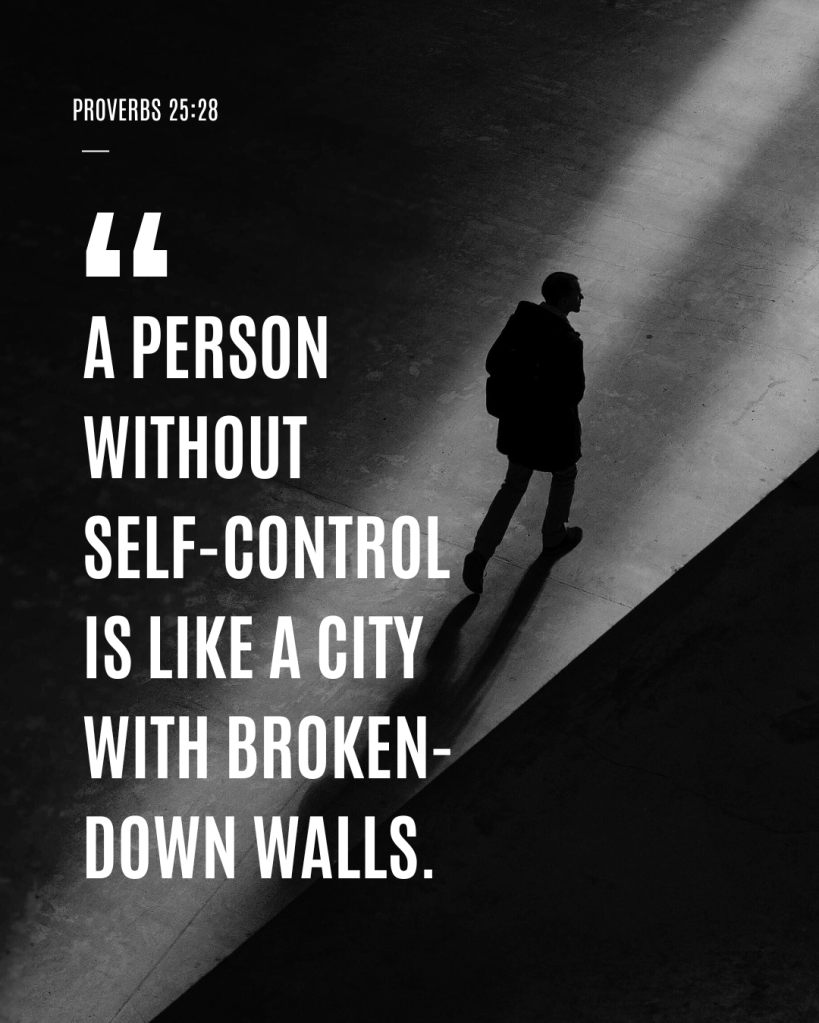
A person without self-control is like a city with broken-down walls. Proverbs 25:28
In I Samuel 24:1-7, David and his men were hiding in a cave when his archenemy, King Saul, entered it alone to relieve himself. At the strong urging of his men, David crept up and cut off a piece of Saul’s robe — unbeknownst to Saul. David’s men saw the moment as a divine intervention and wanted him to kill the king. And he could have. But for one thing. David’s conscience got the best of him. He knew he couldn’t harm the king. It was that simple for him. God didn’t want him to harm the king in any way, shape or form. So he didn’t.
Was David wrong to cut the piece off of Saul’s robe? It isn’t mine to say. Only God knows. David felt convicted by his action and vowed not to harm the king. Why? He knew Saul had been anointed by God, and who was he to harm God’s chosen leader? Even though the soldiers around him urged him to finish off the king, David refused. He knew that he was forbidden to touch the king in a way of harm. So David stepped back and waited for King Saul to walk out of the cave before letting him know that his life had been spared.
Actually, David’s actions that day showed us that good can overcome evil. He didn’t bow to the pressures of his men who wanted the king dead. David served a much bigger King, and he wouldn’t allow the death threats Saul was throwing his way to deter him from his mission. Oh. He knew God had already chosen him to replace Saul as the next king of Israel, but he also knew that it wasn’t his place to decide when Saul breathed his last breath. He would wait patiently for the day of his own coronation before taking the throne.
Even Jesus had what seemed to be a too good to be true offer from Satan himself. Satan shows all the kingdoms of the world to Jesus and promised he could have authority over all of them if only he would worship Satan. Jesus politely refused and reminded Satan that we must worship only the Lord God.
Read about Jesus’ refusal to succumb to Satan’s efforts to tempt him in Luke 4:1-13.
Perhaps it’s time to examine ourselves and our motives. Maybe we need to ask ourselves if we have a tender conscience. Do we ever feel convicted about something we’ve done or said? Do we ever feel convicted to withhold judgment or harsh words or improper actions? Or, do we forge ahead as if we have the right to do or say anything we want without considering the ticking of our conscience? And again, do we ever feel convicted to speak up and risk the aggressive acts of the listener?
He leads the humble in what is right, and teaches the humble his way. Psalm 25:9
Discover more from Mercy for the Day
Subscribe to get the latest posts sent to your email.
 Mercy for the Day